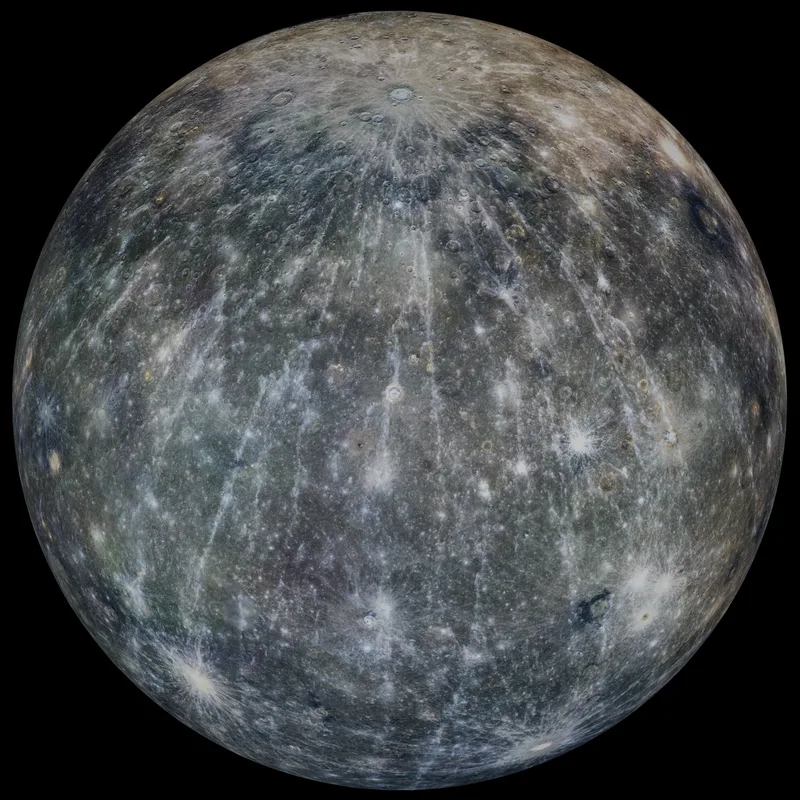
Mercury is the smallest and innermost planet of the Solar System, orbiting the Sun every 88 days. With almost no atmosphere, it experiences extreme temperature differences ranging from intense daytime heat to freezing nights. Its heavily cratered surface, including the massive Caloris Basin, preserves a record of early Solar System impacts. Despite its proximity to the Sun, Mercury contains water ice in permanently shadowed polar craters. Mercury is approximately 4,878 km across.
How to observe Mercury
Mercury is best observed near opposition or greatest elongation as appropriate; steady seeing and repeated short observations reveal more than excessive magnification.
Scientific context
Useful scale comparisons are 0.383 Earth diameters, 0.377 g surface gravity, 0.241 Earth years per orbit. These values are rounded from the catalogue measurements shown on this page.
- Radius
- 2,439 km
- Diameter
- 4,878 km
- Mass
- 3.301E+23 kg
- Mean density
- 5.432 g/cm³
- Surface gravity
- 3.7 m/s² (0.377 g)
- Mean temperature
- 167°C
- Orbital period
- 88 days (0.241 years)
- Semi-major axis
- 0.39 AU
- Mean sunlight travel time
- 3.24 minutes
Source: NASA Science (checked 2026-08-09). Values are rounded catalogue measurements.