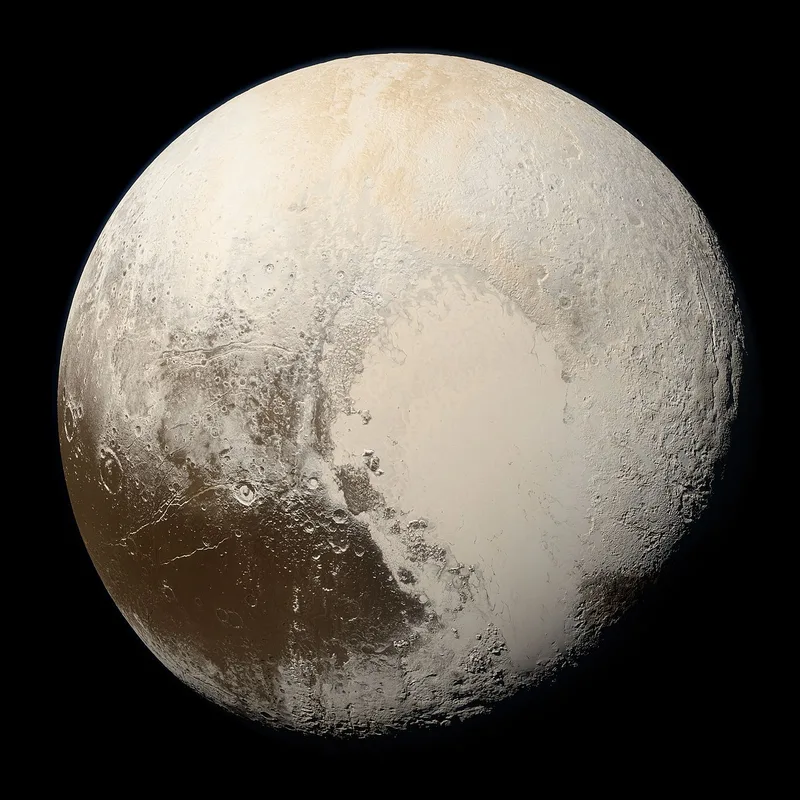
Pluto is a dwarf planet in the Kuiper Belt. Once classified as the ninth planet, it has a complex surface with nitrogen and methane ices, mountains, and a thin atmosphere. Its largest moon, Charon, is large enough that Pluto–Charon are often considered a binary system. Pluto is approximately 2,376.6 km across.
How to observe Pluto
Pluto is generally a challenging visual target. Use a current ephemeris, dark skies, and image stacking when its angular size or brightness is insufficient for direct detail.
Scientific context
Useful scale comparisons are 0.187 Earth diameters, 0.063 g surface gravity, 247.94 Earth years per orbit. These values are rounded from the catalogue measurements shown on this page.
- Radius
- 1,188.3 km
- Diameter
- 2,376.6 km
- Mass
- 1.309E+22 kg
- Mean density
- 1.862 g/cm³
- Surface gravity
- 0.62 m/s² (0.063 g)
- Orbital period
- 90,560 days (247.94 years)
- Semi-major axis
- 39.48 AU
- Mean sunlight travel time
- 328.34 minutes
Source: NASA Science (checked 2026-08-09). Values are rounded catalogue measurements.