Reference image
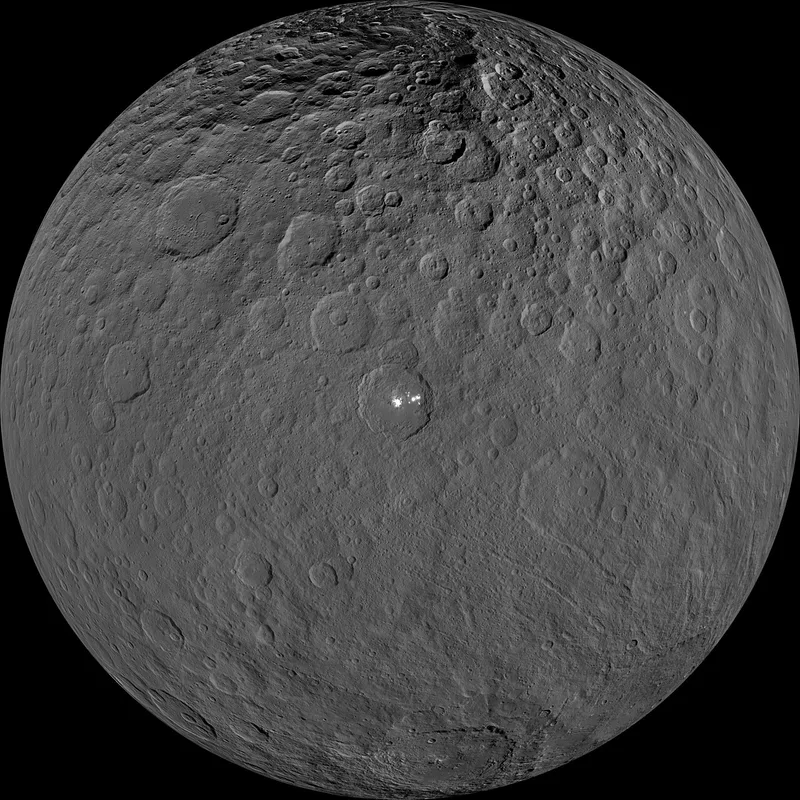
Object guide
Ceres is the largest object in the asteroid belt and the only dwarf planet in the inner Solar System. Spacecraft observations show a differentiated interior and localized bright spots (salt deposits) on its surface. Ceres is approximately 946 km across.
How to observe Ceres
Ceres is generally a challenging visual target. Use a current ephemeris, dark skies, and image stacking when its angular size or brightness is insufficient for direct detail.
Scientific context
Useful scale comparisons are 0.074 Earth diameters, 0.028 g surface gravity, 4.6 Earth years per orbit. These values are rounded from the catalogue measurements shown on this page.
- Radius
- 473 km
- Diameter
- 946 km
- Mass
- 939,000,000,000,000,000,000 kg
- Mean density
- 2.118 g/cm³
- Surface gravity
- 0.27 m/s² (0.028 g)
- Orbital period
- 1,680 days (4.6 years)
- Semi-major axis
- 2.77 AU
- Mean sunlight travel time
- 23.04 minutes
0.074 Earth diameters0.028 g surface gravity4.6 Earth years per orbit
Source: NASA Science (checked 2026-08-09). Values are rounded catalogue measurements.
Interactive orbit model
Aug 13, 2026, 22:251×
Calculated positions / separate exploration scales