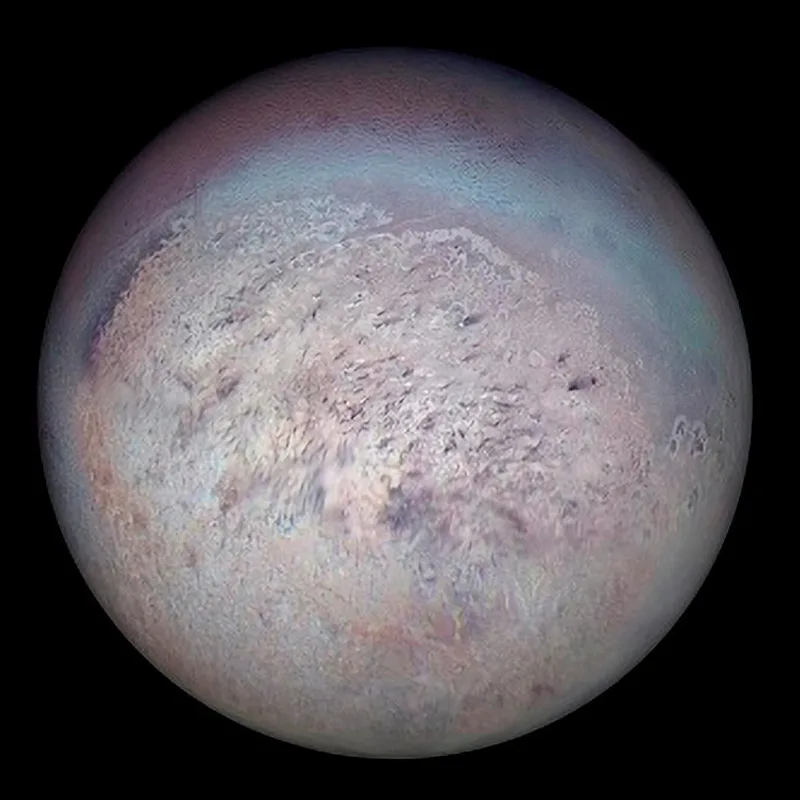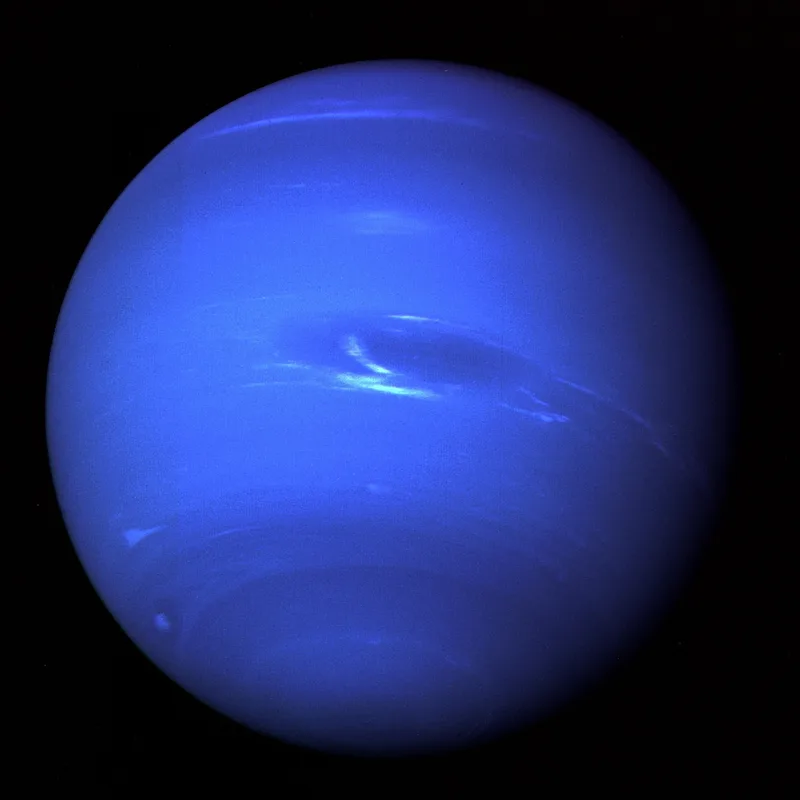
Neptune is an ice giant with very strong winds and weather patterns. Its deep blue color is caused by methane and other atmospheric components. Triton, its largest moon, has a retrograde orbit indicating capture. Neptune is approximately 49,244 km across.
How to observe Neptune
Neptune requires optical aid and a careful finder-chart match. At low power it looks almost stellar; increased magnification may reveal a very small bluish disc in steady air. Do not expect the cloud detail seen in spacecraft photographs. Opposition helps with placement and brightness.
Scientific context
Useful scale comparisons are 3.865 Earth diameters, 1.137 g surface gravity, 164.791 Earth years per orbit. These values are rounded from the catalogue measurements shown on this page.
- Radius
- 24,622 km
- Diameter
- 49,244 km
- Mass
- 1.024E+26 kg
- Mean density
- 1.638 g/cm³
- Surface gravity
- 11.15 m/s² (1.137 g)
- Mean temperature
- -200°C
- Orbital period
- 60,190 days (164.791 years)
- Semi-major axis
- 30.05 AU
- Mean sunlight travel time
- 249.92 minutes
Source: NASA Science ↗
At your observing time
3 Oct 2026, 14:54 UTC · Change observing time
- Apparent magnitude
- 7.8
- Disc diameter
- 2.4 arcsec
- Constellation
- Pisces
- Next opposition
- 28 Sep 2027, 14:08 UTC