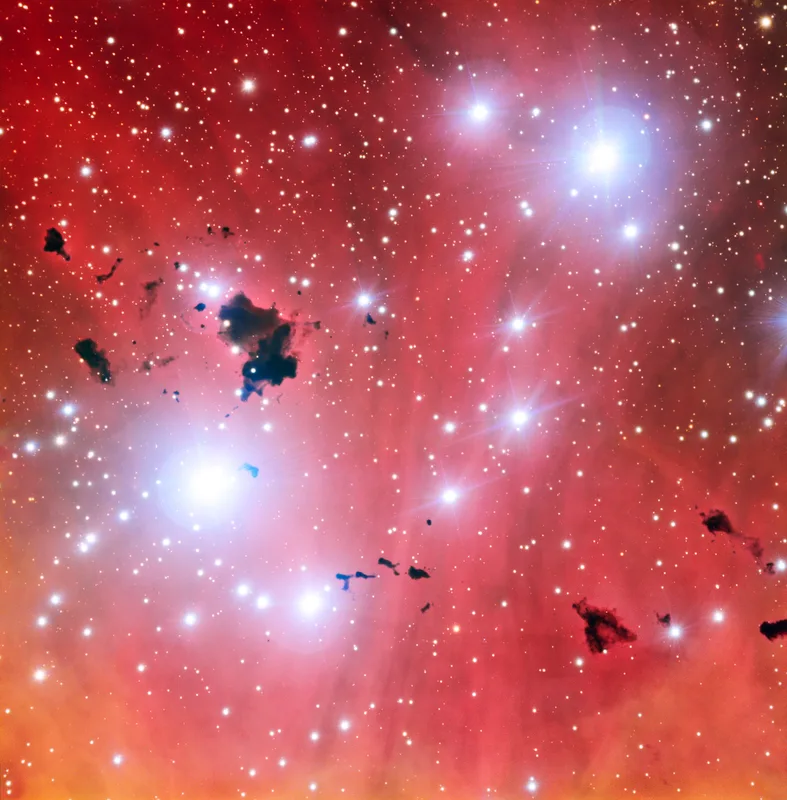
Observer's guide
About Lambda Centauri Nebula
Lambda Centauri Nebula (C100) is catalogued as an emission nebula in Centaurus. Its J2000 position is RA 11:38:00, Dec -62:18:00, corresponding to 174.5833 degrees RA and -63.3728 degrees Dec. The local catalogue places it about 6,000 light-years away. No consistent angular diameter is available in the source record.
Observing tips
StarWatchr rates this as a very easy target at magnitude 4.5. It is associated with spring observing, with midnight placement typically strongest around March. From 52 degrees north its theoretical meridian altitude is about 0 degrees; local horizons and the live altitude chart determine the practical window.
Its brightness makes it a practical binocular or small-telescope candidate when it is well above the horizon.
What to expect
The SIMBAD classification for the matched source is OpC. A published radial velocity value is -0.9 km/s. The SIMBAD record currently connects it to 192 bibliographic references.
Confirm the framing in the live sky atlas before choosing a field of view. Use the listed unknown arcminute extent to check framing, and treat catalogue magnitude as integrated brightness rather than a direct measure of visual contrast.