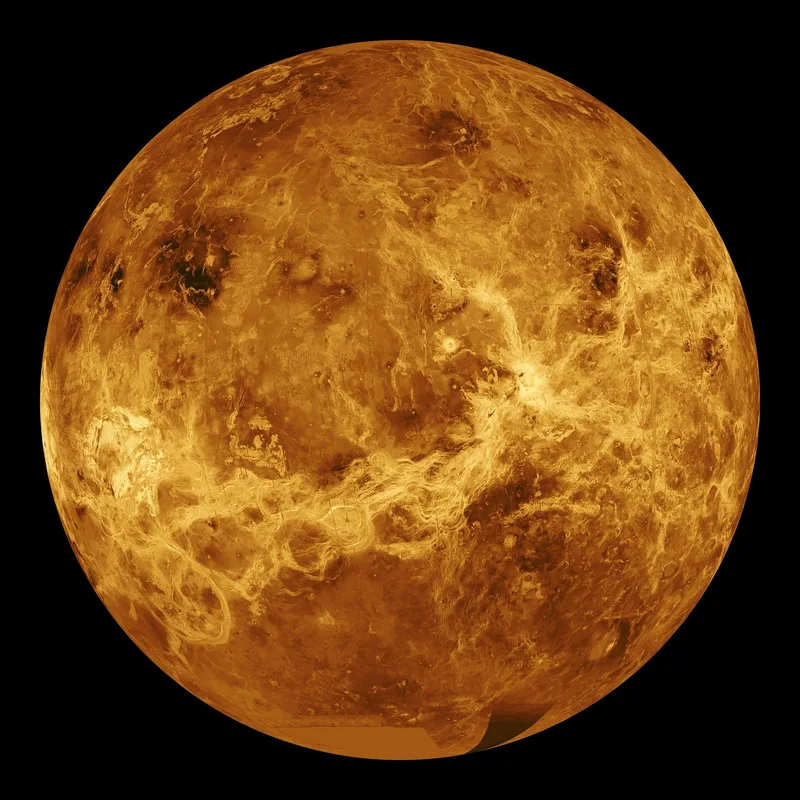
Venus is almost Earth's twin in size, at 12,102 km across, but its conditions are hostile. A thick carbon-dioxide atmosphere and clouds of sulfuric acid trap heat in a runaway greenhouse effect, keeping the surface around 464°C, hotter than Mercury. It also spins backward and very slowly: one rotation takes about 5,832 hours, longer than its 224.7-day year.
How to observe Venus
Venus shows changing phases, not visible surface features: its surface is hidden by cloud. A thinner crescent is usually larger in apparent size. Observe in twilight with the Sun safely below the horizon, and use modest magnification before increasing it.
Scientific context
Galileo's observations of the full cycle of Venus's phases in 1610 were key evidence that the planets orbit the Sun. Because the clouds hide the ground, its volcanic plains and large shield volcanoes were mapped with radar, most completely by the Magellan orbiter in the early 1990s.
- Radius
- 6,051 km
- Diameter
- 12,102 km
- Mass
- 4.867E+24 kg
- Mean density
- 5.244 g/cm³
- Surface gravity
- 8.87 m/s² (0.904 g)
- Mean temperature
- 464°C
- Orbital period
- 224.7 days (0.615 years)
- Semi-major axis
- 0.72 AU
- Mean sunlight travel time
- 5.99 minutes
At your observing time
21 Nov 2026, 10:34 · now
- Apparent magnitude
- -4.8
- Disc diameter
- 45.6 arcsec
- Constellation
- Virgo
- Next greatest elongation
- 3 Jan 2027, 17:56 UTC