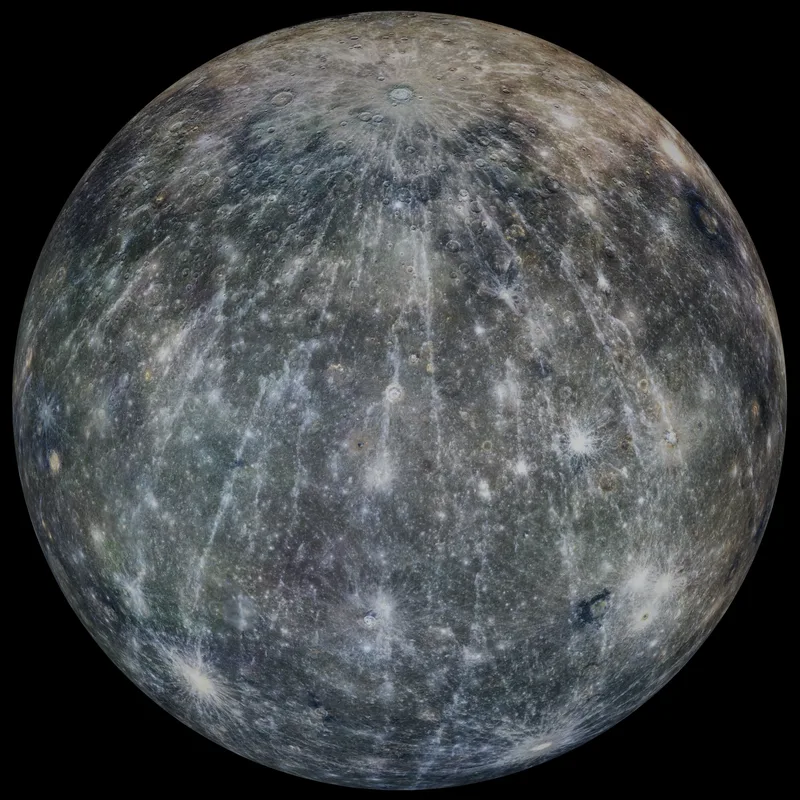
Mercury is the smallest planet and the closest to the Sun, completing an orbit every 88 days at an average distance of 0.39 AU. It has almost no atmosphere, so its surface swings between scorching daytime heat and deep cold at night. The heavily cratered surface, including the huge Caloris Basin, records the early bombardment of the Solar System, and permanently shadowed craters near the poles still hold water ice.
How to observe Mercury
Look near greatest elongation, when Mercury is furthest from the Sun in our sky. A clear horizon and a steep evening or morning ecliptic matter as much as the elongation angle. Its small disc shows phases through a telescope. Wait until the Sun is below the horizon before searching with optics.
Scientific context
MESSENGER orbited Mercury from 2011 to 2015, mapping the whole planet and confirming the polar ice. A density of 5.43 g/cm³ reflects a large iron core, which also produces a weak global magnetic field. Its slow 1,407-hour rotation combines with its fast orbit so that one solar day on Mercury lasts longer than its year.
- Radius
- 2,439 km
- Diameter
- 4,878 km
- Mass
- 3.301E+23 kg
- Mean density
- 5.432 g/cm³
- Surface gravity
- 3.7 m/s² (0.377 g)
- Mean temperature
- 167°C
- Orbital period
- 88 days (0.241 years)
- Semi-major axis
- 0.39 AU
- Mean sunlight travel time
- 3.24 minutes
At your observing time
21 Nov 2026, 10:34 · now
- Apparent magnitude
- -0.6
- Disc diameter
- 6.6 arcsec
- Constellation
- Libra
- Next greatest elongation
- 3 Feb 2027, 06:20 UTC