Observer's guide
About NGC 6333
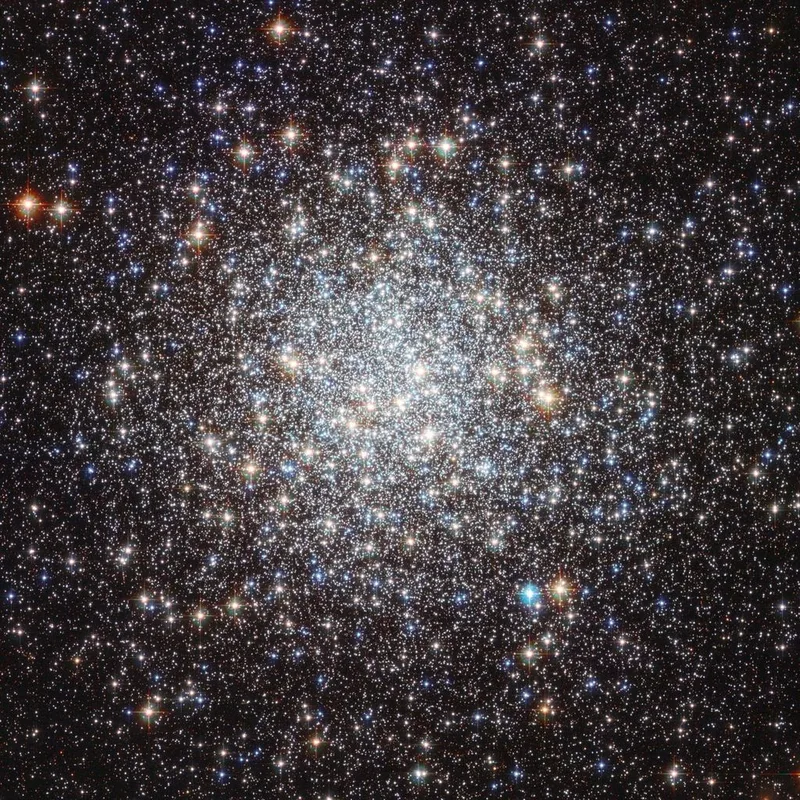
M9 (NGC 6333) is a small globular cluster in southern Ophiuchus, about 26,700 light-years from us and close to the direction of the galactic center. It shines at magnitude 7.7 and spans only about 5 to 9 arcminutes, so it looks more modest than its neighbors M10 and M12. Dust between us and the cluster dims its light, and dark nebulae lie close by in the same field.
Observing tips
Start from Eta Ophiuchi (Sabik) and move about 3.5 degrees south-southeast; M9 shows in binoculars as a faint fuzzy star. A 70 to 100 mm scope shows a small, round glow with a brighter center but little resolution. In a 200 mm telescope at 150x to 200x, the outer edge breaks into faint stars while the core stays granular. From northern Europe it stays below 20 degrees altitude, so observe it as it crosses the meridian and use averted vision to trace the halo.
A small telescope under reasonably dark skies is a good starting point; use the live altitude chart to choose its highest point.
What to expect
As one of the globulars lying closest to the galactic center, M9 sits in a crowded, dusty region, and interstellar extinction makes it appear fainter than it otherwise would. Like other globulars, it consists of very old stars that formed early in the history of the Milky Way.
M9 is small, so use 1,000 to 2,000 mm to show detail. A wider 400 to 600 mm frame can instead include the dark nebulae and Milky Way star fields around it.