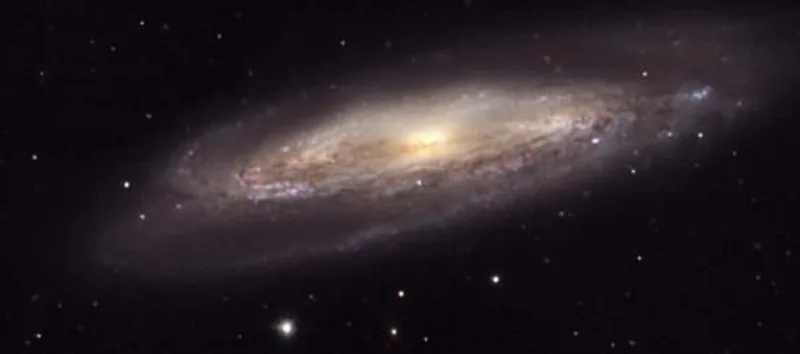
Observer's guide
About NGC 4192
Long and thin, M98 (NGC 4192) is a highly inclined spiral on the western side of the Virgo Cluster, in Coma Berenices. It shines at magnitude 10.1 and lies about 60 million light-years away. Its narrow 9.5 by 3.2 arcminute outline and position next to a naked-eye star make it easy to locate, even if it is faint once you get there.
Observing tips
Start at Denebola and move about 6.5 degrees east to 6 Comae, a 5th-magnitude star; M98 lies about half a degree west of it. Binoculars rarely show it. A 70 to 100 mm telescope at 60x reveals a faint, thin streak with a slightly brighter center. With 200 mm at 100x to 150x, the streak lengthens and the core brightens, but the arms stay hidden. M99 lies about 1.3 degrees to the east-southeast, so you can see both in a short sweep.
Because it is faint, use a larger aperture where possible, avoid bright Moon conditions, and use averted vision.
What to expect
M98 is a highly inclined spiral galaxy with a large bulge and a dusty disk. Its radial velocity of about -107 km/s shows that it is moving toward us, the result of its high speed within the Virgo Cluster.
The thin disk of M98, about 9.5 by 3.2 arcminutes, suits 1000 to 1200 mm. Long integration shows its dust lanes, and a 400 to 600 mm view includes M99 and the star 6 Comae.