Observer's guide
About Owl Nebula
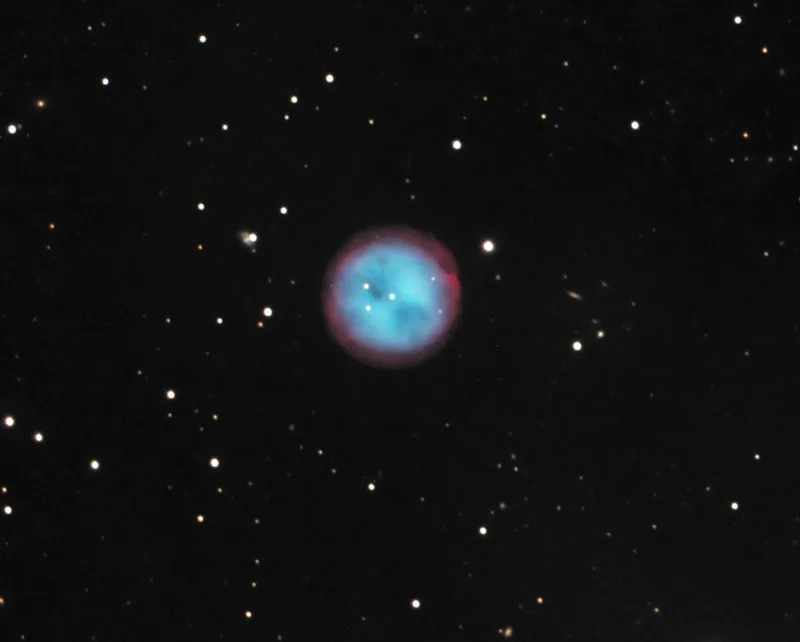
Two dark patches give the Owl Nebula its name: in larger telescopes they look like the eyes of an owl staring out of a round, pale disk. Cataloged as M97 or NGC 3587, this planetary nebula lies just below the bowl of the Big Dipper in Ursa Major, about 2,600 light-years away. At magnitude 9.9 over 3.4 arcminutes, its light is spread thin, so it needs a dark sky.
Observing tips
Start at Merak (Beta Ursae Majoris), one of the two Pointer stars of the Big Dipper's bowl, and move about 2.3 degrees southeast. Binoculars show at best a faint round spot under dark skies. A 70 to 100 mm telescope shows a small, round, gray disk of fairly even brightness. With 200 mm and an OIII or UHC filter at 100x to 150x, the two dark eyes appear with averted vision. M108 lies less than a degree to the northwest, so both fit in a wide low-power field.
Because it is faint, use a larger aperture where possible, avoid bright Moon conditions, and use averted vision.
What to expect
M97 formed when a Sun-like star shed its outer layers near the end of its life. The dark eyes are thought to be the ends of a cylindrical cavity in the shell, seen at an angle, while the hot central white dwarf makes the gas glow.
At about 3.4 arcminutes, M97 fits well at 1500 to 2000 mm, or at 600 to 800 mm with M108 in the same frame. Ha and OIII capture the colors of the shell and its faint outer halo.