Observer's guide
About NGC 4736
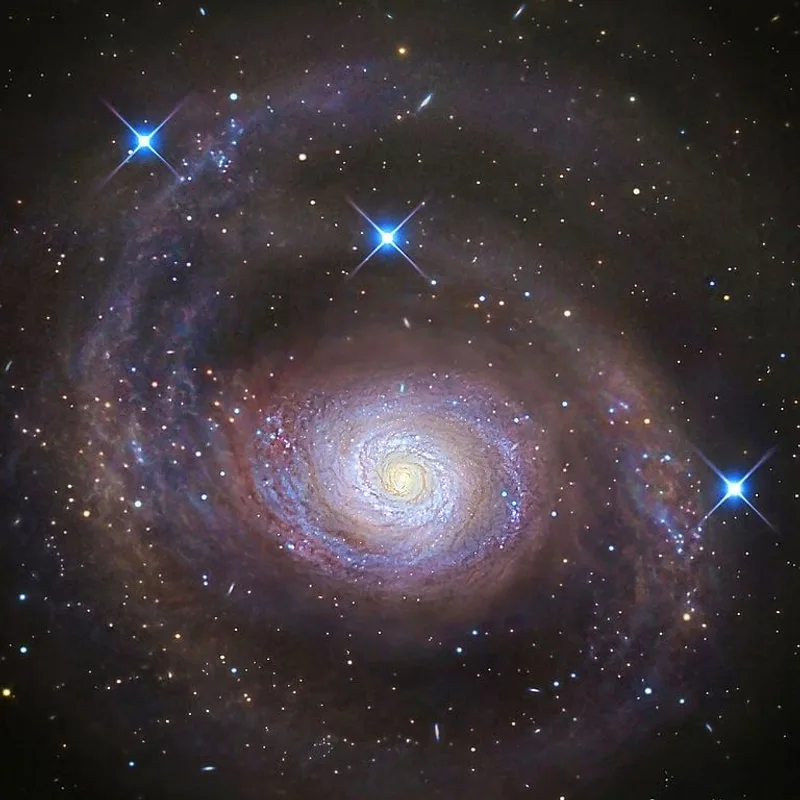
Sometimes called the Croc's Eye Galaxy, M94 (NGC 4736) has one of the brightest cores of any galaxy in the northern sky. It shines at magnitude 8.2 in Canes Venatici, about 14.5 million light-years away. A ring of intense star formation surrounds its nucleus, and a much fainter outer disk lies well beyond what the eye can see.
Observing tips
M94 forms a triangle with Cor Caroli and Chara (Beta Canum Venaticorum), lying about 3 degrees from each star. Binoculars show a bright, star-like haze. A 70 to 100 mm telescope at 60x shows a small, bright core surrounded by an oval halo. In a 200 mm scope at 100x to 150x, the halo becomes more extended, with a sharp inner region that hints at the starburst ring. Its high surface brightness makes it a good galaxy even under moderately light-polluted skies.
A small telescope under reasonably dark skies is a good starting point; use the live altitude chart to choose its highest point.
What to expect
M94 is a spiral galaxy with a starburst ring around its core, where new stars form at a high rate. Deep images show a faint outer disk or ring far beyond the bright inner region, making the galaxy much larger than it appears visually.
At 1000 to 1500 mm, the bright core and inner ring of M94 fill the frame nicely. Long integration under dark skies brings out the faint outer disk, which is much larger than the visual size.