Observer's guide
About NGC 6341
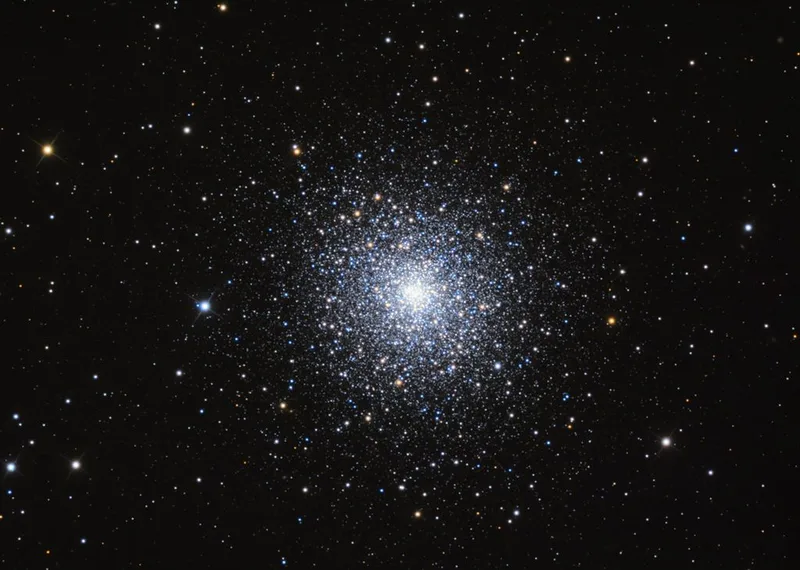
Overshadowed by M13 in the same constellation, M92 (NGC 6341) is one of the brightest globular clusters in the northern sky. It shines at magnitude 6.4 in Hercules, about 26,400 light-years away, and passes almost overhead from mid-northern latitudes. It is also one of the oldest known globulars, which makes it a key object for studying the early Milky Way.
Observing tips
Start at Pi Herculis, the northeastern star of the Keystone, and move about 6 degrees north; M92 lies in a sparse area toward the border with Draco. Binoculars show a bright, fuzzy star. A 70 to 100 mm telescope at 80x shows a dense round glow with a bright core and some grainy edges. With 200 mm at 150x to 200x, the outer halo resolves into many faint stars, and the core becomes partly resolved in steady skies. Its high altitude in early summer gives sharp views.
A small telescope under reasonably dark skies is a good starting point; use the live altitude chart to choose its highest point.
What to expect
M92 is one of the oldest and most metal-poor globular clusters in the Milky Way, with an age close to that of the galaxy itself. Its stars formed from almost pristine gas, which makes the cluster useful for setting a lower limit on the age of the universe.
At about 12 arcminutes, M92 fits well at 800 to 1200 mm. Short subframes prevent the core from saturating and keep the colors of its red giant stars.