Observer's guide
About NGC 4569
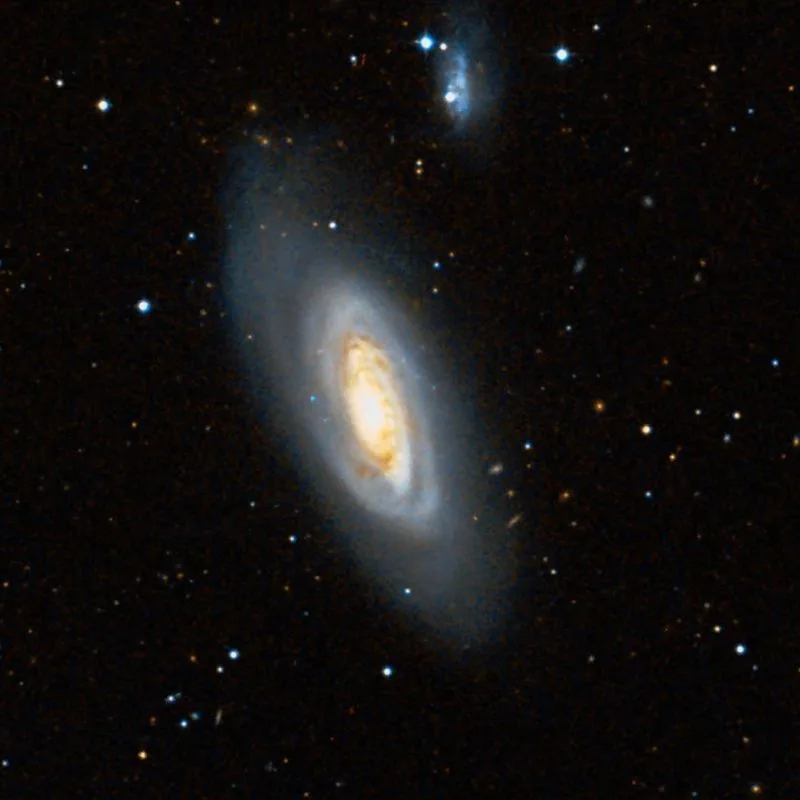
Among the large spirals of the Virgo Cluster, M90 (NGC 4569) stands out for its long, tilted disk, about 9.5 by 4.7 arcminutes across. It shines at magnitude 9.5 about 60 million light-years away. Unlike most galaxies, M90 is moving toward us, with a radial velocity of about -199 km/s, a result of its orbit within the massive cluster.
Observing tips
Find M89 about 1.2 degrees east of M87, then move about 40 arcminutes north-northeast to M90. Binoculars show little. A 70 to 100 mm telescope at 60x reveals an elongated glow with a brighter center. With 200 mm at 100x to 150x, the oval stretches out and its edges show a slightly patchy texture with averted vision. Choose a moonless night, since the outer disk is faint.
Because it is faint, use a larger aperture where possible, avoid bright Moon conditions, and use averted vision.
What to expect
M90 is an anemic spiral: much of its gas has been stripped away by the hot gas of the Virgo Cluster as it moves through it. As a result, its outer disk forms few new stars, giving the galaxy a smooth, faded look in images.
At 1000 to 1200 mm, the tilted disk of M90 fills the frame nicely. Long integration reveals faint plumes of stripped gas and dust, and a wider 400 to 600 mm view can include M89 and M58.