Observer's guide
About Lagoon Nebula
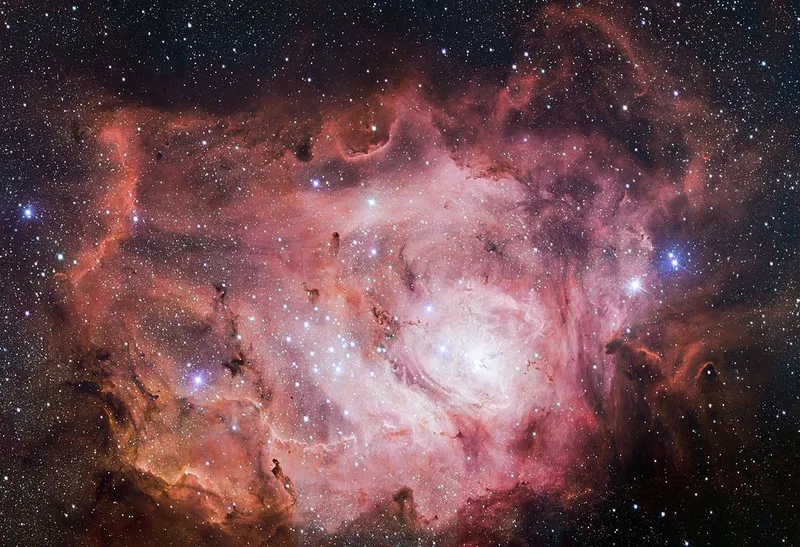
The Lagoon Nebula, M8 (NGC 6523), is a large star-forming cloud in Sagittarius, visible to the naked eye from a dark site as a brighter patch in the summer Milky Way. It covers about 90 by 40 arcminutes, three times the width of the full Moon, and lies roughly 5,200 light-years away. A dark lane of dust splits the glowing gas, and the young cluster NGC 6530 sits on its eastern side.
Observing tips
From Gamma Sagittarii (Alnasl), the tip of the Teapot's spout, look about 6 degrees north; M8 is the obvious glow there, with the Trifid Nebula 1.5 degrees farther north. Binoculars show a hazy patch with a cluster at one end. A 70 to 100 mm scope at 30x to 50x reveals the dark lane and the bright western core around the star 9 Sagittarii and the compact Hourglass region. With 200 mm and a UHC or OIII filter, the nebula grows much larger and shows mottled structure. From 52 degrees north it peaks near 14 degrees, so pick a transparent night.
Its brightness makes it a practical binocular or small-telescope candidate when it is well above the horizon.
What to expect
M8 is an HII region, a cloud of hydrogen ionized by ultraviolet light from hot young stars such as those in NGC 6530 and Herschel 36. Star formation is still under way inside it, and small dark Bok globules that may collapse into stars are scattered across the bright nebula.
At around 1.5 degrees long, the Lagoon fits a 400 to 600 mm focal length, or up to 1,000 mm for the Hourglass core. H-alpha brings out the faint outer nebulosity, and a wider 200 mm frame can include the Trifid.