Observer's guide
About Virgo A
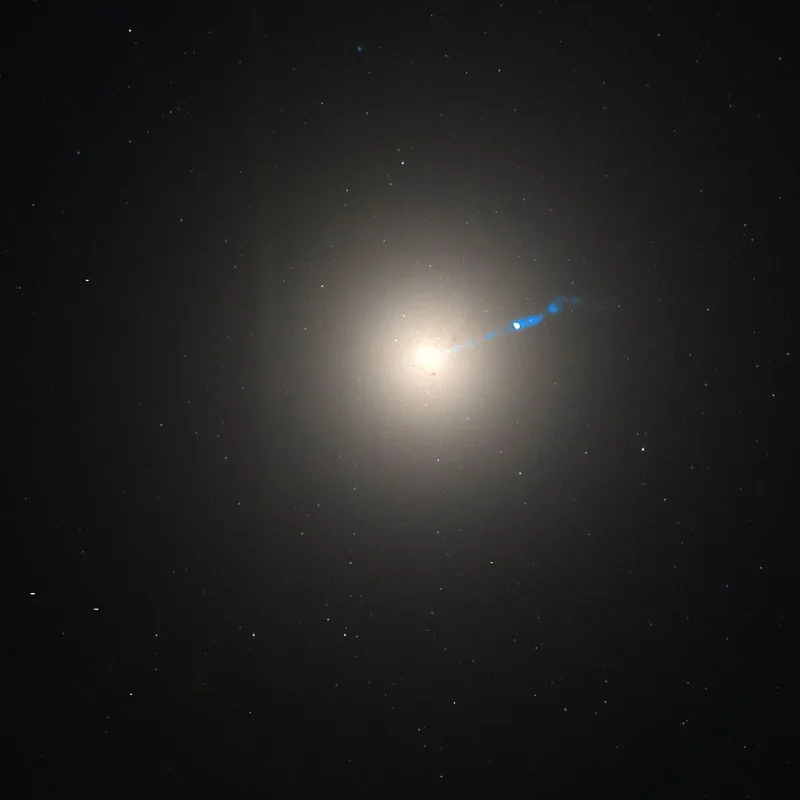
Virgo A, better known as M87 (NGC 4486), is the giant elliptical galaxy at the center of the Virgo Cluster, about 60 million light-years away. Its core hosts the supermassive black hole whose shadow was imaged by the Event Horizon Telescope in 2019, the first image of its kind. Visually it shines at magnitude 8.6 and is one of the easier Virgo galaxies to find.
Observing tips
Start at M84 and M86, midway between Denebola and Vindemiatrix, and move just over a degree southeast to find M87. Binoculars show a small round haze. In a 70 to 100 mm telescope it appears as a bright, round glow with a strong center and no visible structure. A 200 mm scope makes the halo larger and brighter, but the famous jet is beyond visual reach for most amateur telescopes. Use medium power to pick out several small galaxies around it.
A small telescope under reasonably dark skies is a good starting point; use the live altitude chart to choose its highest point.
What to expect
M87 is a giant elliptical galaxy with more than ten thousand globular clusters, far more than the Milky Way. Its central black hole, billions of times the mass of the Sun, powers a jet of particles that extends thousands of light-years from the core.
At about 7 arcminutes, M87 frames well at 1000 to 1500 mm. Short exposures and careful processing can show the jet leaving the core, and long integration captures the faint halo and its swarm of globular clusters.