Observer's guide
About NGC 4406
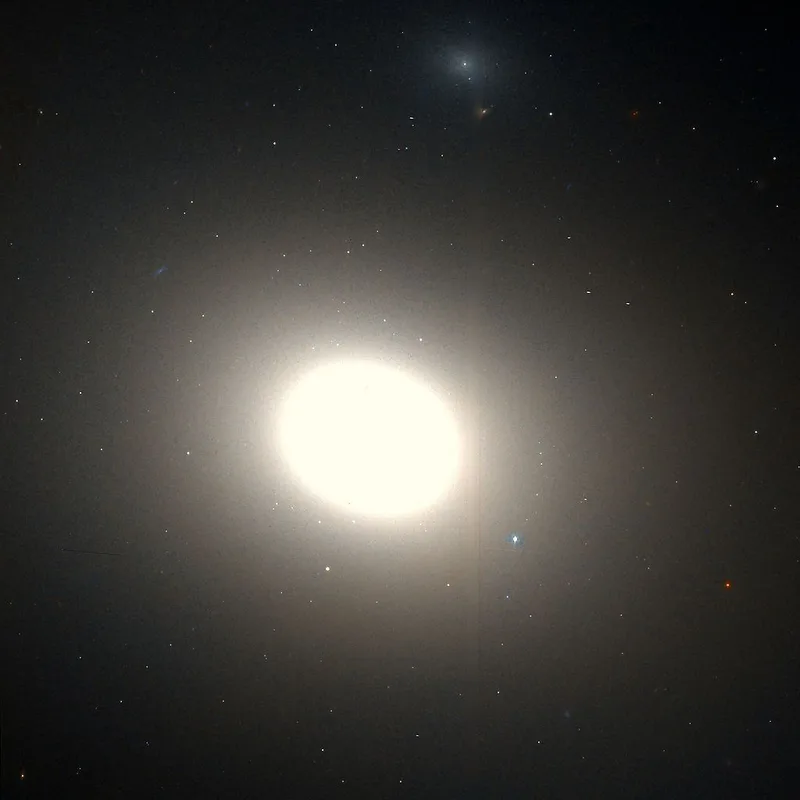
Few galaxies beyond our own neighborhood are moving toward us, but M86 (NGC 4406) is one of them. This lenticular galaxy of magnitude 8.9 lies about 60 million light-years away in the heart of the Virgo Cluster, where it forms the start of Markarian's Chain together with M84. Its radial velocity of about -306 km/s means its light is blueshifted, unlike nearly all galaxies outside the Local Group.
Observing tips
Aim midway between Denebola and Vindemiatrix to find M84 and M86, which appear about 17 arcminutes apart. In binoculars both are small hazy spots. A 70 to 100 mm telescope shows M86 as a larger, slightly oval glow compared with the rounder M84. With 200 mm or more at 80x to 100x, the halo extends further and several fainter galaxies of Markarian's Chain appear to the east and northeast, including the pair NGC 4435 and 4438, known as the Eyes.
A small telescope under reasonably dark skies is a good starting point; use the live altitude chart to choose its highest point.
What to expect
M86 is a large lenticular galaxy falling through the Virgo Cluster at high speed. As it moves, the hot gas of the cluster strips material from it, leaving a long tail of X-ray-emitting gas behind it.
A 400 to 600 mm focal length captures M86, M84 and the Eyes in one frame. Long integration reveals faint plumes and the extended halo, along with many small background galaxies.