Observer's guide
About Cigar Galaxy
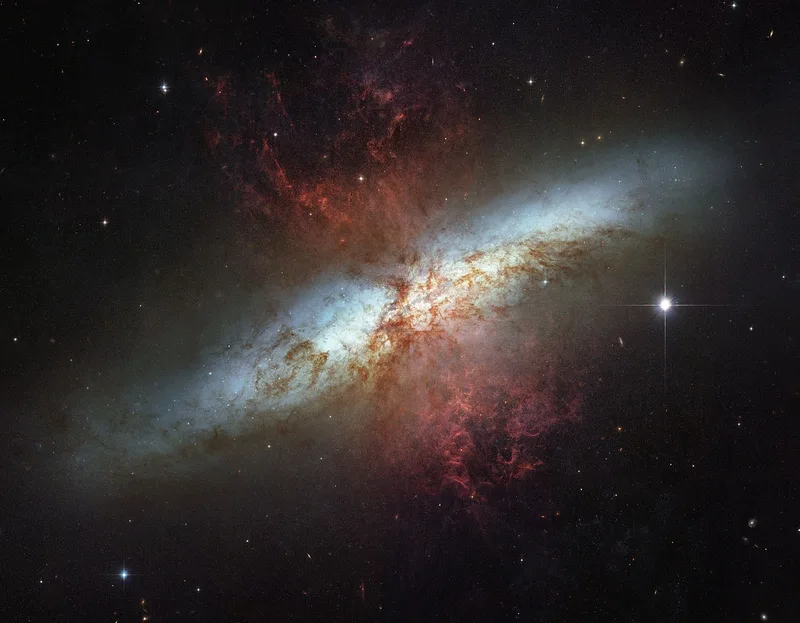
Seen nearly edge-on, the Cigar Galaxy, M82 (NGC 3034), is the starburst partner of M81 in Ursa Major, about 12 million light-years away. At magnitude 8.4 and 11 by 4.6 arcminutes, it appears as a bright, narrow streak with clear dark lanes in larger telescopes. Its central region forms stars at a very high rate, and in 2014 it hosted SN 2014J, one of the closest Type Ia supernovae of recent decades.
Observing tips
Find M81 by extending the line from Phecda through Dubhe by about the same distance again; M82 lies less than a degree north of M81. In binoculars it is a faint sliver next to the brighter oval of M81. A 70 to 100 mm telescope at 50x shows a sharply defined, elongated streak. With 200 mm at 100x to 150x, dark dust lanes cut across the middle, giving it a mottled, irregular look. It shows more structure than almost any other galaxy in medium-sized scopes, and steady, transparent skies reveal the most detail.
A small telescope under reasonably dark skies is a good starting point; use the live altitude chart to choose its highest point.
What to expect
M82 is a starburst galaxy, forming stars many times faster than the Milky Way. Gravitational interaction with M81 drove gas into its center, and the resulting supernovae and stellar winds blow a huge outflow of gas and dust out of its disk, seen as red filaments in hydrogen-alpha images.
At 400 to 600 mm you can frame M82 with M81, while 1200 mm or more shows its dust lanes. Add long Ha exposures to capture the red filaments of the superwind streaming out above and below the disk.