Observer's guide
About Bode's Galaxy
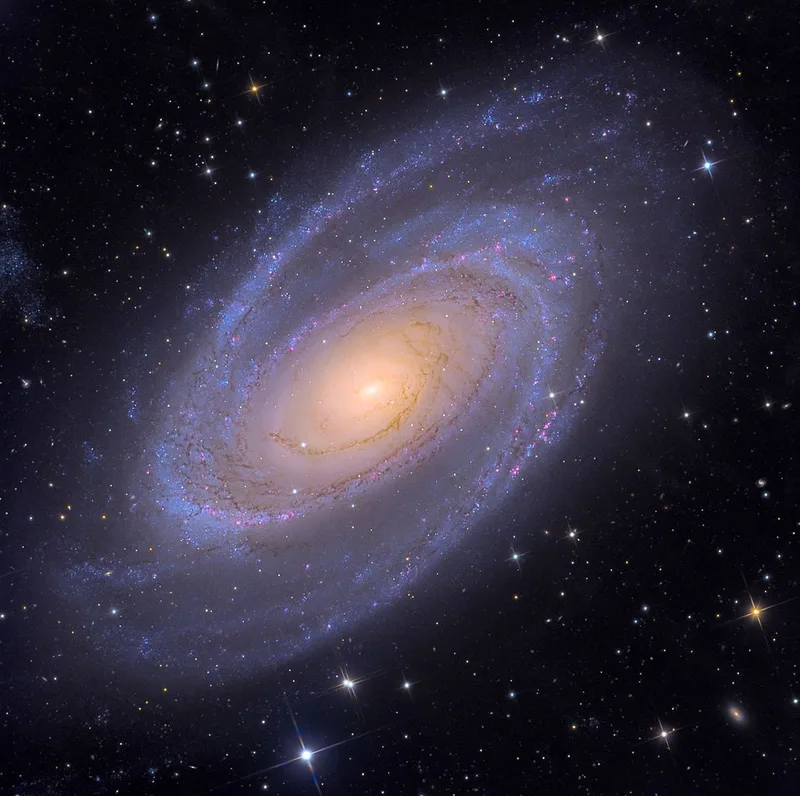
Bode's Galaxy, M81 (NGC 3031), is one of the brightest galaxies in the northern sky, shining at magnitude 6.9 in Ursa Major about 12 million light-years away. It forms a well-known pair with M82, which lies less than a degree to the north. At 26 by 14 arcminutes it is large and bright enough to see in binoculars from a dark site.
Observing tips
Draw a line from Phecda (Gamma Ursae Majoris) through Dubhe (Alpha), then extend it about the same distance beyond Dubhe; M81 and M82 lie near the end of that line. Binoculars show M81 as an oval glow with M82 nearby. In a 70 to 100 mm telescope at 40x to 60x, both galaxies fit in one field, M81 as a large oval with a bright core and M82 as a thin streak. With 200 mm or more, the halo grows and dark-sky observers may see hints of the spiral arms with averted vision. Low magnification gives the best view of the pair together.
A small telescope under reasonably dark skies is a good starting point; use the live altitude chart to choose its highest point.
What to expect
M81 is a grand-design spiral galaxy and the dominant member of a small group that includes M82 and NGC 3077. A close encounter with M82 a few hundred million years ago left streams of hydrogen gas between the galaxies and triggered star formation in both.
A 400 to 600 mm focal length frames M81 and M82 together. Long integration under dark skies brings out the outer arms of M81 and the faint integrated flux nebula, dust in our own galaxy that lies in front of the pair.