Observer's guide
About NGC 6093
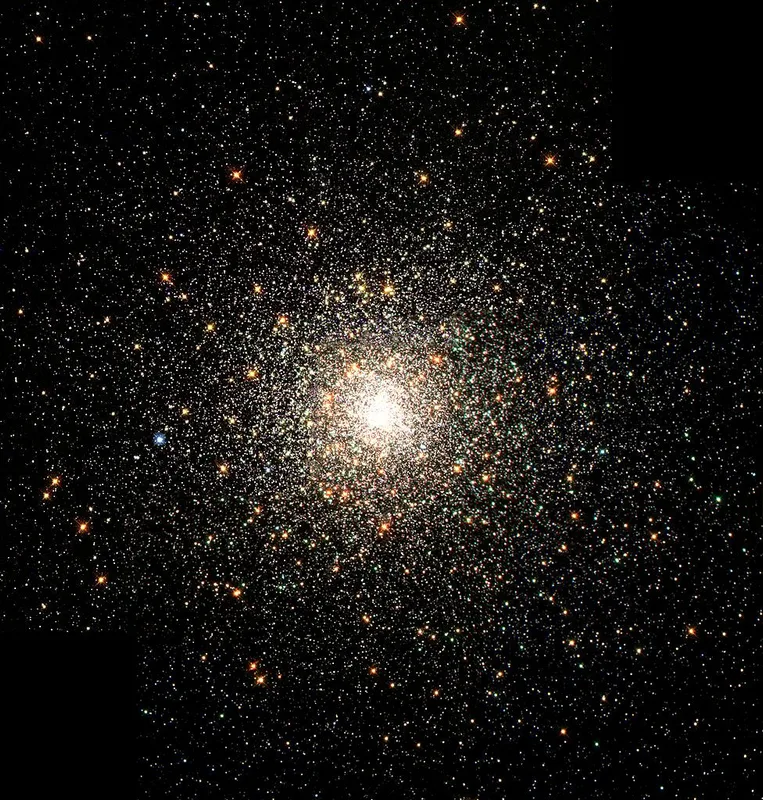
Between Antares and Acrab in Scorpius lies M80 (NGC 6093), one of the densest globular clusters in the Milky Way. It shines at magnitude 7.3 about 27,400 light-years away, and it is compact enough to look almost like a fuzzy star at low power. In 1860 a nova, T Scorpii, flared up inside the cluster and briefly outshone it.
Observing tips
Find Antares and Acrab (Beta Scorpii), the northern star of the scorpion's head, and look about halfway between them. Binoculars show a small, round, fuzzy star. A 70 to 100 mm telescope at 100x shows a compact glow with a very bright center. With 200 mm at 150x to 200x, the edges become grainy, but the dense core resists resolution. M4 lies about 4 degrees to the south-southeast, close to Antares, so the two make a good contrast in cluster styles. At 52 degrees north, M80 climbs only to about 15 degrees.
A small telescope under reasonably dark skies is a good starting point; use the live altitude chart to choose its highest point.
What to expect
M80 is a very dense globular cluster, with hundreds of thousands of stars packed into a small volume. Close encounters in its core produce many blue stragglers, stars that appear young because they gained mass through mergers or collisions.
Compact and bright, M80 needs 1500 mm or more to resolve its edges. Use short exposures and good seeing; a wider frame at 300 to 500 mm can include M4 and Antares.