Observer's guide
About Ptolemy's Cluster
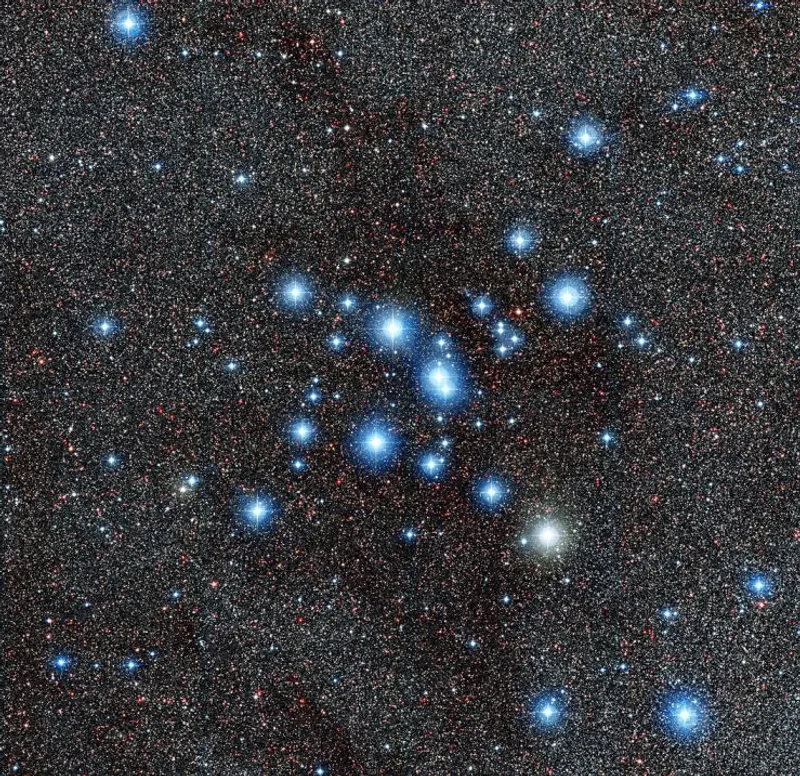
Ptolemy's Cluster, M7 (NGC 6475), was described by Claudius Ptolemy around AD 130, making it one of the earliest deep-sky objects on record. It lies near the stinger of Scorpius, about 800 light-years away, and at magnitude 4.1 it is plainly visible to the naked eye from dark southern sites. Including its outlying stars, the cluster spreads over more than a degree against a rich Milky Way background.
Observing tips
From the stinger pair Shaula and Lesath, move about 5 degrees east-northeast; M7 appears as a bright knot in the Milky Way, with M6 about 4 degrees farther to the northwest. Binoculars are ideal and show dozens of stars. In a 70 to 100 mm scope, use your lowest power, 20x to 30x, because higher magnification spreads the cluster beyond the field. A 200 mm scope shows the dark dust lanes and faint star fields behind it, but a rich-field view is still best. Above about 50 degrees north it skims the horizon or does not rise at all.
Its brightness makes it a practical binocular or small-telescope candidate when it is well above the horizon.
What to expect
M7 is a fairly nearby open cluster around 200 million years old, made up mostly of blue-white main sequence stars plus a few yellow giants. Its stars formed together from one cloud and still share a common motion through the galaxy.
Its full extent needs a wide field, 200 to 400 mm on a full-frame or APS-C camera. Include the surrounding star clouds and dark nebulae, and use a shorter camera lens if you also want M6 in the frame.