Observer's guide
About NGC 2068
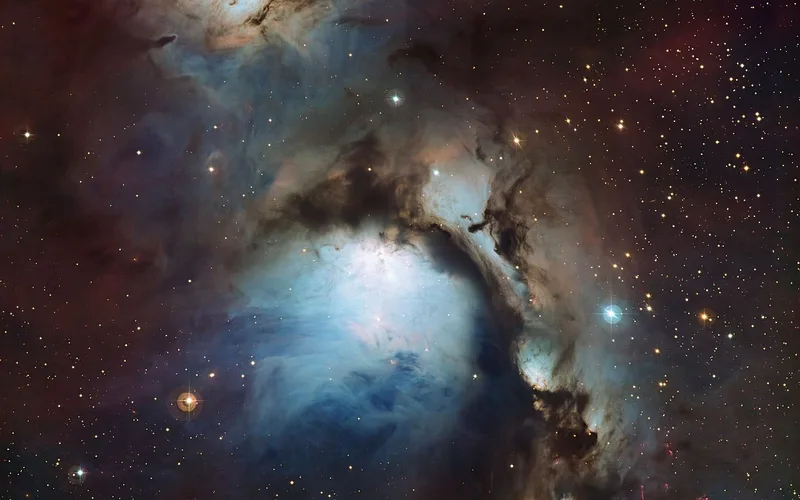
Just northeast of Orion's Belt lies M78 (NGC 2068), a reflection nebula of magnitude 8.3 about 1,600 light-years away. Unlike the glowing gas of the Orion Nebula, M78 shines by starlight scattered off dust surrounding young stars. In a telescope it looks like a small comet with a fan-shaped tail, and it is one of the easiest reflection nebulae for small instruments.
Observing tips
Start at Alnitak, the eastern star of Orion's Belt, and move about 2.5 degrees northeast; M78 is the brightest patch in this area. Binoculars show a small, hazy spot. In a 70 to 100 mm telescope at 50x to 80x, you see a fan or comet shape with two faint stars embedded in it. A 200 mm scope shows more of the fan and the fainter nebula NGC 2071 just to the north. Nebula filters do little for a reflection nebula, so rely on dark skies and averted vision instead.
A small telescope under reasonably dark skies is a good starting point; use the live altitude chart to choose its highest point.
What to expect
M78 is part of the Orion B molecular cloud, a large region of gas and dust where new stars are still forming. The dust scatters blue light from hot young stars, and the area also hosts McNeil's Nebula, which appeared in 2004 when a young star flared.
At about 8 by 6 arcminutes, M78 fits well at 600 to 1000 mm, while 300 to 400 mm captures the surrounding dark clouds. Use broadband RGB with long integration; Ha adds little beyond some faint nearby emission.