Observer's guide
About Cetus A
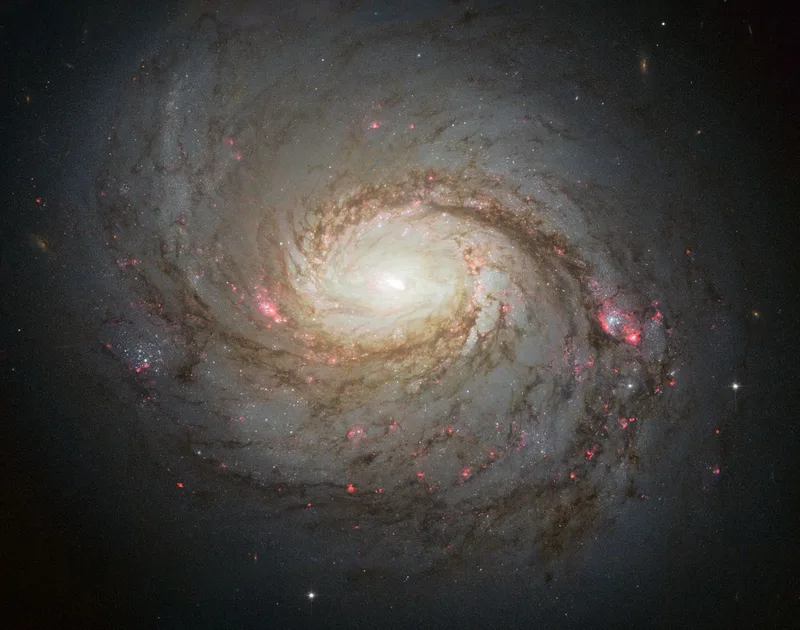
Bright, compact and active, M77 (NGC 1068) in Cetus is one of the best known active galaxies in the sky and one of the first Seyfert galaxies identified. Also called Cetus A, a name that reflects its radio emission, and sometimes the Squid Galaxy, it lies about 60 million light-years away and shines at magnitude 8.9. Its bright, compact nucleus is powered by a supermassive black hole hidden behind dust.
Observing tips
Locate Gamma Ceti in the head of the whale, then drop about 3.5 degrees south-southwest to Delta Ceti; M77 sits less than a degree east-northeast of Delta. Binoculars can pick it up as a faint, star-like glow under dark skies. A 70 to 100 mm telescope shows a small, bright oval with an almost stellar core. In 200 mm at 150x and more, a fainter round halo surrounds the bright inner region. Higher magnification helps separate the core from its surroundings.
A small telescope under reasonably dark skies is a good starting point; use the live altitude chart to choose its highest point.
What to expect
M77 is a spiral galaxy with a Seyfert 2 nucleus, in which a thick ring of dust hides the brightest central region from direct view. Studies of its polarized light helped establish the unified model of active galaxies.
At about 7 by 6 arcminutes, M77 suits 1200 to 1500 mm. Short exposures keep the bright core under control, while long integration reveals the faint outer disk that extends well beyond the visual size.