Observer's guide
About Little Dumbbell Nebula
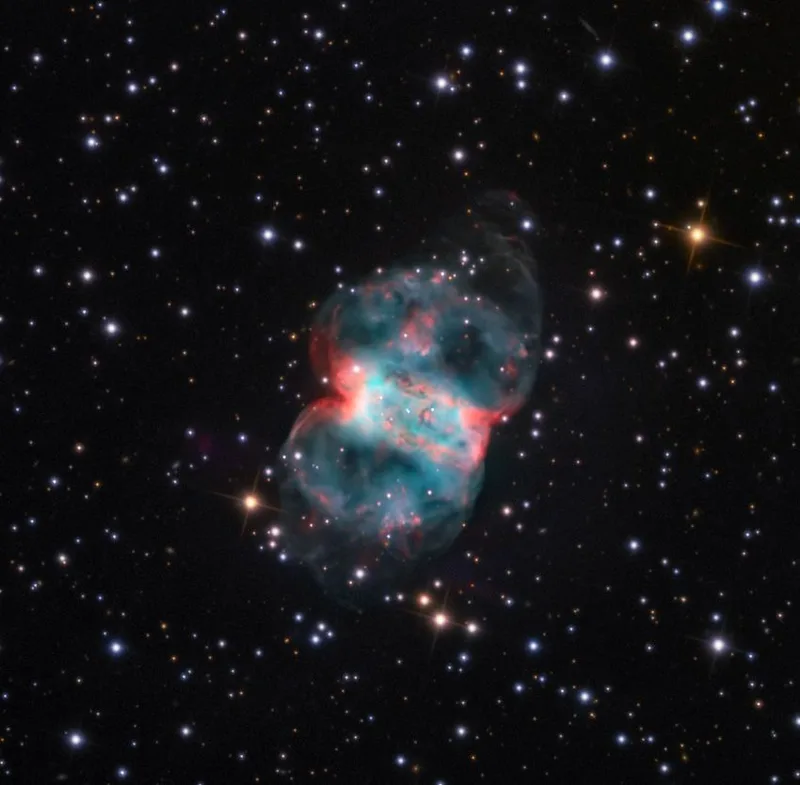
The Little Dumbbell Nebula, M76, is a planetary nebula in Perseus about 3,400 light-years away. It also goes by the Cork and Butterfly Nebula, and it carries two NGC numbers, NGC 650 and 651, because early observers took its two lobes for separate objects. At magnitude 10.1 it is one of the faintest entries in the Messier catalog, though its small size keeps its surface brightness reasonable.
Observing tips
Start at Phi Persei, close to the border with Andromeda, and move just under 1 degree north to find M76. Binoculars are not enough. A 70 to 100 mm telescope at 80x to 100x shows a small, elongated glow, a bit like a tiny rectangle. With 200 mm at 120x to 150x, the two brighter lobes and the faint outer wings become visible, and an OIII or UHC filter improves contrast noticeably. It passes almost overhead from 52 degrees north, so take advantage of autumn nights when it is high.
Because it is faint, use a larger aperture where possible, avoid bright Moon conditions, and use averted vision.
What to expect
Like other planetary nebulae, M76 formed when a dying Sun-like star shed its outer layers. Its bright central bar is thought to be a ring of gas seen edge-on, while the fainter wings are material flowing out from the poles, giving it a bipolar shape.
At about 2.7 by 1.8 arcminutes, M76 needs 1500 mm or more to show its structure. Ha and OIII bring out the colors of the lobes, while long integration reveals the faint outer loops.