Observer's guide
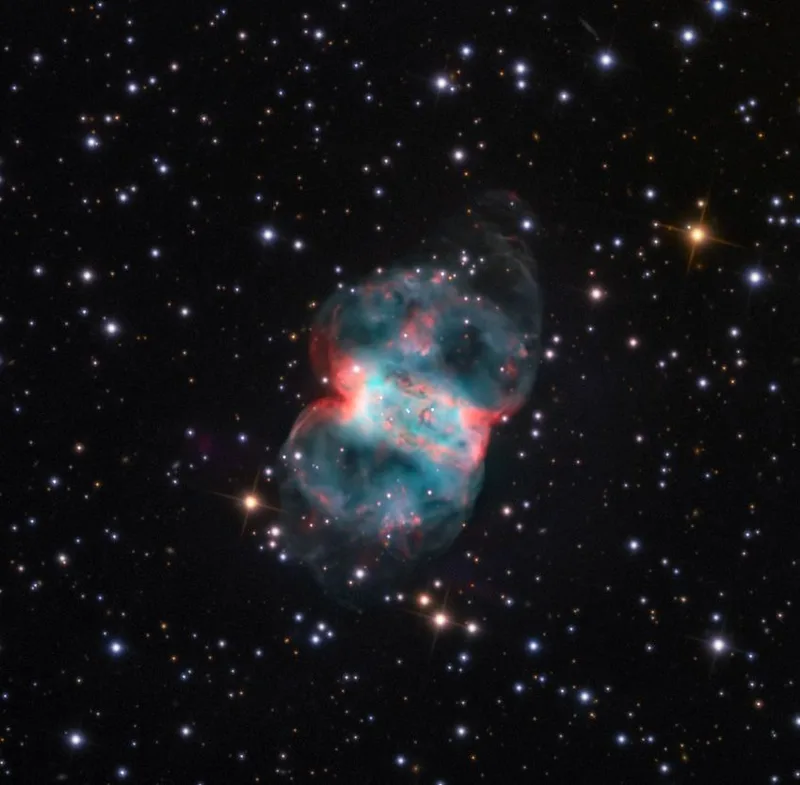
About Little Dumbbell Nebula
Little Dumbbell Nebula (M76) is catalogued as a planetary nebula in Perseus. Its J2000 position is RA 01:42:19.69, Dec +51:34:31.7, corresponding to 25.5819 degrees RA and 51.5754 degrees Dec. The local catalogue places it about 3,400 light-years away. Its referenced angular extent is approximately 2.31 by 2.31 arcminutes.
Observing tips
This is rated as a moderate target at magnitude 10.1. It is associated with autumn observing, with midnight placement typically strongest around October. From 52 degrees north its theoretical meridian altitude is about 89.6 degrees; local horizons and the live altitude chart determine the practical window.
Because it is faint, use a larger aperture where possible, avoid bright Moon conditions, and use averted vision.
What to expect
The SIMBAD classification for the matched source is PN. A published radial velocity value is -23.6 km/s. The SIMBAD record currently connects it to 387 bibliographic references.
At roughly 2.3 arcminutes across, it benefits from a narrower field and adequate image scale. Use the listed 2.31 by 2.31 arcminute extent to check framing, and treat catalogue magnitude as integrated brightness rather than a direct measure of visual contrast.