Observer's guide
About NGC 6864
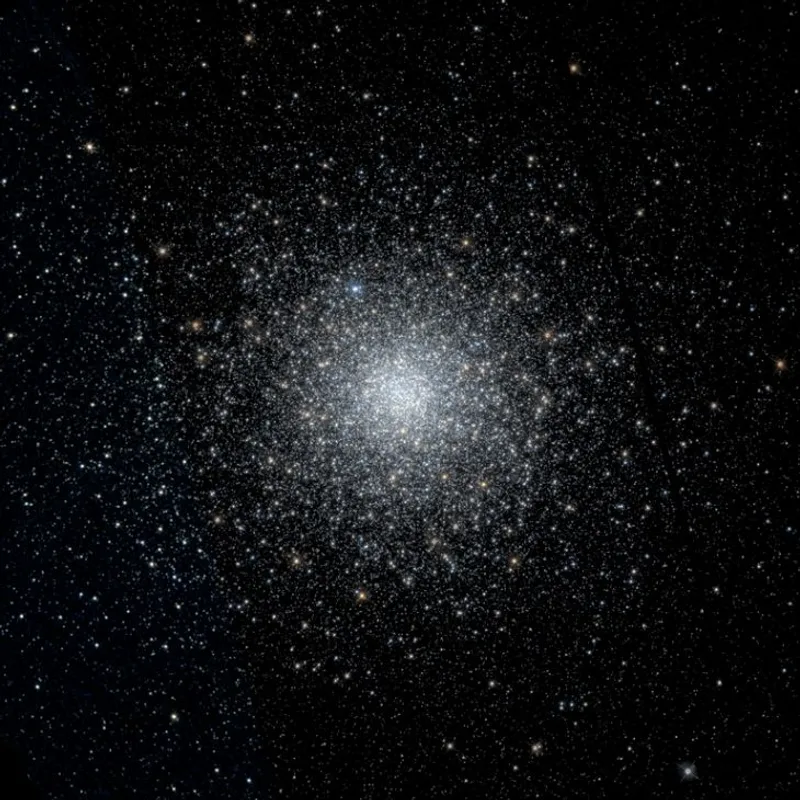
Far from the busy Teapot region of Sagittarius, near the border with Capricornus, lies M75 (NGC 6864), one of the most compact and distant globular clusters in the Messier catalog. It is about 57,700 light-years away and shines at magnitude 8.5, brighter than its distance suggests. Its small size means it looks almost star-like at low power, so it is easy to pass over.
Observing tips
From Beta Capricorni (Dabih), move about 8 degrees southwest into a sparse area of Sagittarius; M75 appears as a small fuzzy star in a finder or binoculars. A 70 to 100 mm telescope at 80x shows a tiny, bright round glow with a very concentrated core. With 200 mm or more at 200x, the outer halo becomes granular, but the core stays unresolved. From 52 degrees north it peaks at about 16 degrees altitude, so pick a clear night and observe it near the meridian.
A small telescope under reasonably dark skies is a good starting point; use the live altitude chart to choose its highest point.
What to expect
M75 is a dense globular cluster in the outer halo of the Milky Way and one of the more centrally concentrated globulars known. Its great distance means only its brightest giant stars are within reach of amateur telescopes.
M75 is small, so use 1500 mm or more to show any structure. Short exposures preserve the core, and good seeing matters more than total integration time for this target.