Observer's guide
About NGC 6994
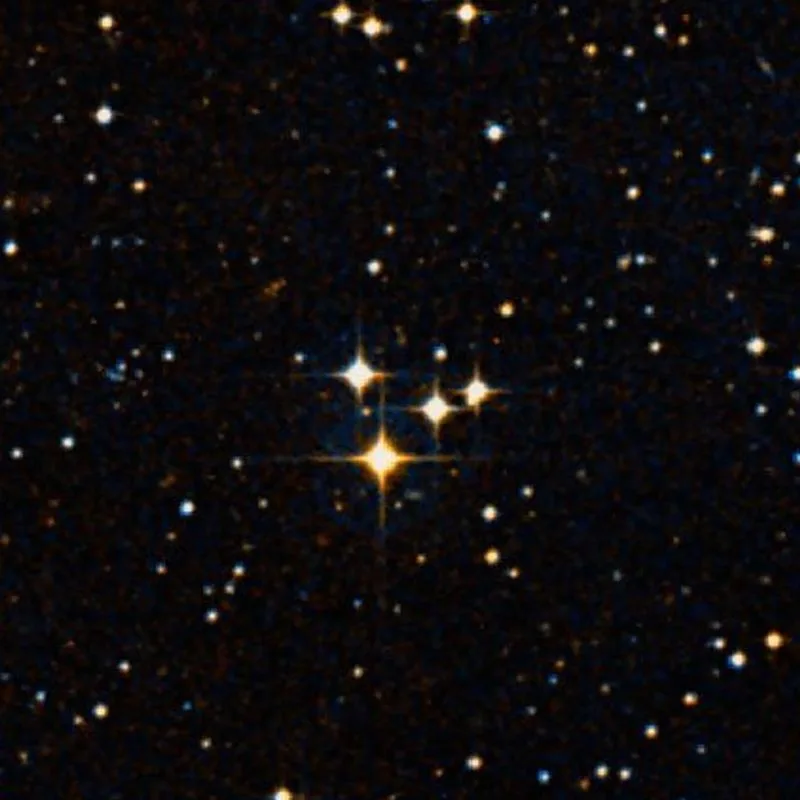
Four faint stars in a Y shape make up M73 (NGC 6994) in Aquarius, one of the few Messier entries that is neither a cluster nor a nebula. Charles Messier logged it as a small group that at first looked nebulous, and it kept its place in the catalog even though it is simply an asterism. The group has a combined magnitude of about 9, spans roughly 2.8 arcminutes, and lies about 1.3 degrees east of the globular cluster M72.
Observing tips
First find M72 about 3 degrees south-southeast of Epsilon Aquarii, then move roughly 1.3 degrees east. M73 is too small and faint to stand out in binoculars. In a 70 to 100 mm telescope at 50x to 100x you see a tight knot of four stars, three brighter and one fainter, forming a small Y or triangle with a tail. A 200 mm scope makes the stars sharper but adds little else. It is a modest sight, best visited as a quick stop after M72.
Because it is faint, use a larger aperture where possible, avoid bright Moon conditions, and use averted vision.
What to expect
Studies of the distances and motions of the four stars indicate that they are not physically related; they only line up from our point of view. A sparse cluster remnant was once proposed, but the chance alignment explanation is now widely accepted.
At under 3 arcminutes, M73 needs 1000 mm or more to look like more than a few stars. It works best as a curiosity in a wider 400 to 600 mm frame with M72 nearby.