Observer's guide
About NGC 6681
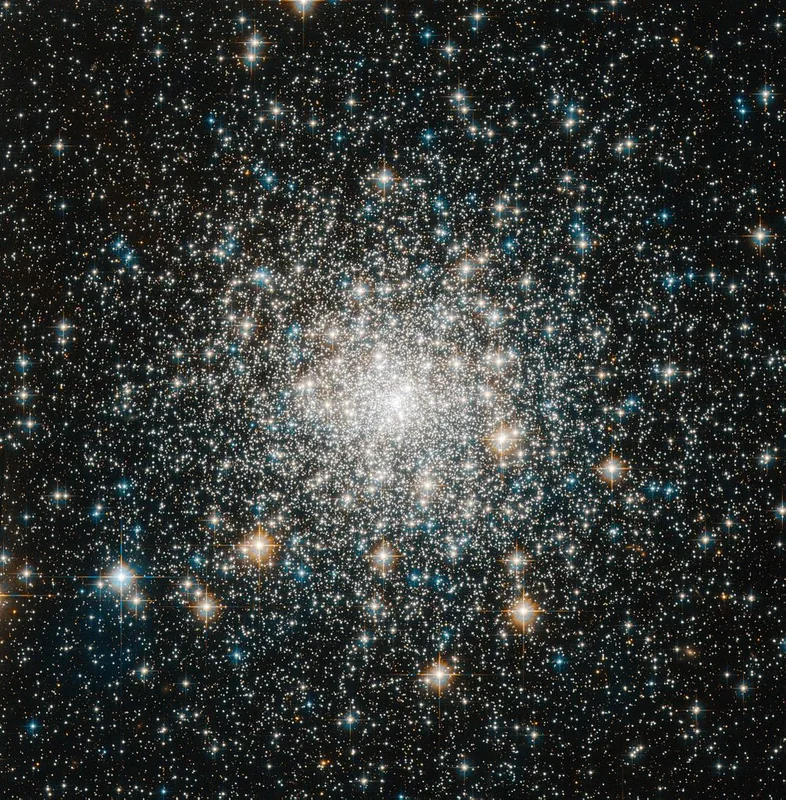
Roughly halfway between Kaus Australis and Ascella along the bottom of the Sagittarius Teapot lies M70 (NGC 6681), a small globular cluster of magnitude 7.9 about 28,000 light-years away. It looks like a slightly fainter, tighter twin of nearby M69. Comet Hale-Bopp was discovered close to M70 in 1995, a detail many observers remember it for.
Observing tips
Draw a line from Epsilon Sagittarii (Kaus Australis) to Zeta Sagittarii (Ascella) and look near its midpoint; M70 sits there, about 2.5 degrees east of M69. Binoculars show it as a faint, star-like smudge. A 70 to 100 mm telescope shows a small round glow with a brighter center. At 200 mm and 150x or more, the outer edges turn grainy and a few stars resolve around the tight core. At 52 degrees north it barely clears 6 degrees, so it is far better placed for observers farther south.
A small telescope under reasonably dark skies is a good starting point; use the live altitude chart to choose its highest point.
What to expect
M70 is a core-collapsed globular cluster: over billions of years, gravitational encounters between its stars have driven many of them into an extremely dense center. Like M69, it orbits fairly close to the center of the Milky Way.
M70 needs 1000 mm or more for detail, though a wide field at 200 to 400 mm can include M69 and the stars along the base of the Teapot. Short subframes prevent the dense core from saturating.