Observer's guide
About Butterfly Cluster
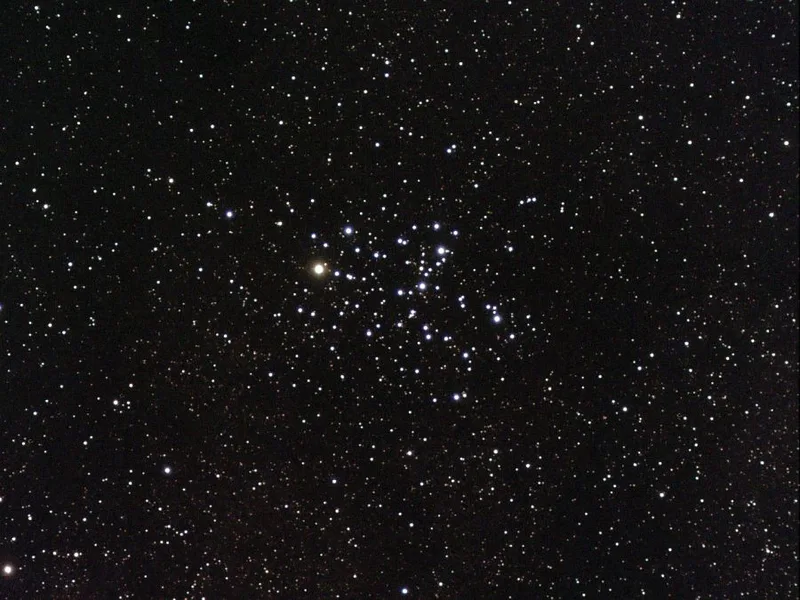
The Butterfly Cluster, M6 (NGC 6405), is a bright open cluster above the tail of Scorpius, about 2,000 light-years away. At magnitude 5.3 and around 15 arcminutes across, it shows a pattern of stars that really does resemble a butterfly with open wings. Its brightest member, the orange variable BM Scorpii, sits on the eastern wing and stands out against the bluish-white stars around it.
Observing tips
Find the curl of stars at the tail of Scorpius and look about 5 degrees north of the stinger stars Shaula and Lesath, or about 4 degrees northwest of M7. Binoculars show both clusters together on a dark night. A 70 to 100 mm scope at 30x to 50x gives the best view of the butterfly shape, while a 200 mm instrument adds many fainter members but can lose the outline at high power. From 52 degrees north it rises less than 6 degrees, so you need a flat southern horizon; from southern Europe or the southern US it is far easier.
Its brightness makes it a practical binocular or small-telescope candidate when it is well above the horizon.
What to expect
M6 is a young open cluster, roughly 100 million years old, and most of its light comes from hot blue B-type stars. BM Scorpii is an evolved orange giant that has already left the main sequence, which explains its different color.
A focal length of 400 to 600 mm frames the cluster with some surrounding Milky Way. Keep stars small and colors natural so the orange of BM Scorpii contrasts with the blue members, and image only near the meridian if you are far north.