Observer's guide
About NGC 6637
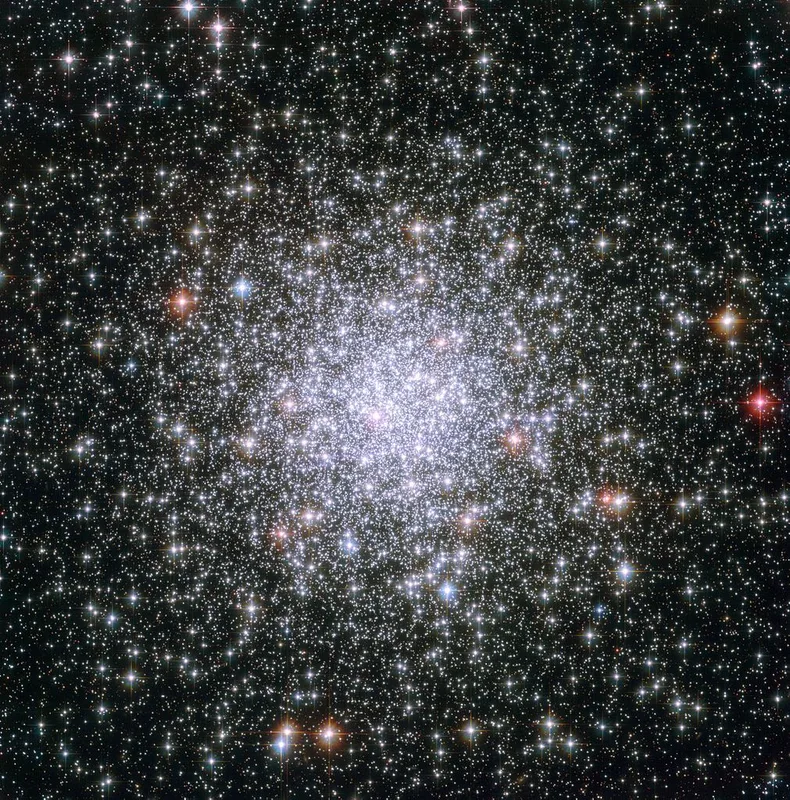
Close to Kaus Australis, the bright star at the base of the Sagittarius Teapot, sits M69 (NGC 6637), a compact globular cluster of magnitude 7.6. It lies about 26,700 light-years away, toward the central regions of the Milky Way. Together with M70 a short hop to the east, it makes a neat pair of small globulars for observers with a low southern horizon.
Observing tips
From Kaus Australis (Epsilon Sagittarii), go about 2.5 degrees northeast to reach M69. Binoculars show a small fuzzy star. In a 70 to 100 mm telescope it looks like a bright, round glow with a dense center. A 200 mm scope at 150x to 200x starts to resolve the outer edges, but the core stays tight. At 52 degrees north it transits under 6 degrees high, so this is mostly a target for observers at lower latitudes or those with a perfectly clear southern horizon. Pan about 2.5 degrees east to add M70.
A small telescope under reasonably dark skies is a good starting point; use the live altitude chart to choose its highest point.
What to expect
M69 is one of the more metal-rich globular clusters, with a higher share of heavy elements than typical halo globulars, which fits its orbit in the inner Milky Way. Its light reaches us through dust near the galactic center, which dims it somewhat.
Small and bright, M69 frames well at 1000 mm or more, while 300 to 400 mm captures both M69 and M70 in rich Milky Way fields. Image near the meridian, as low altitude blurs fine detail quickly.