Observer's guide
About NGC 4590
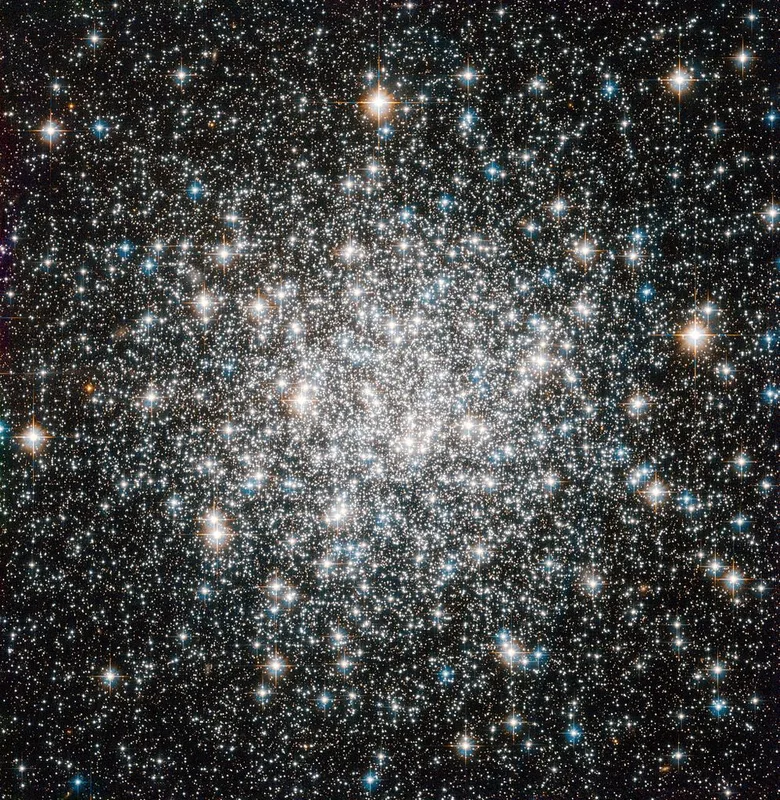
Below Corvus in the constellation Hydra lies M68 (NGC 4590), a globular cluster of magnitude 7.8 about 33,300 light-years away. It is fairly loose for a globular, so its stars begin to resolve in moderate apertures. From northern Europe it stays low in the south even at its best, while observers at lower latitudes see it much higher and more clearly.
Observing tips
Start at Beta Corvi, the lower left star of the Corvus quadrilateral as seen from the north, and move about 3.5 degrees south-southeast. Binoculars show a small round glow. A 70 to 100 mm telescope shows a soft, round haze with a gentle brightening toward the center. In a 200 mm scope at 150x the edges break into faint stars, with the core partly resolved in steady air. At 52 degrees north it rises only about 11 degrees, so choose a night with a clean southern horizon and catch it as it crosses the meridian.
A small telescope under reasonably dark skies is a good starting point; use the live altitude chart to choose its highest point.
What to expect
M68 is one of the more metal-poor globular clusters in the Milky Way, which means its stars formed from gas containing very few heavy elements, early in the history of the galaxy. Like other globulars, it orbits in the galactic halo far from the disk.
M68 spans roughly 10 arcminutes, so 800 to 1200 mm frames it with some surrounding field. From northern sites, keep sessions short and centered on the meridian, and expect softer stars from the long path through the atmosphere.