Observer's guide
About NGC 2682
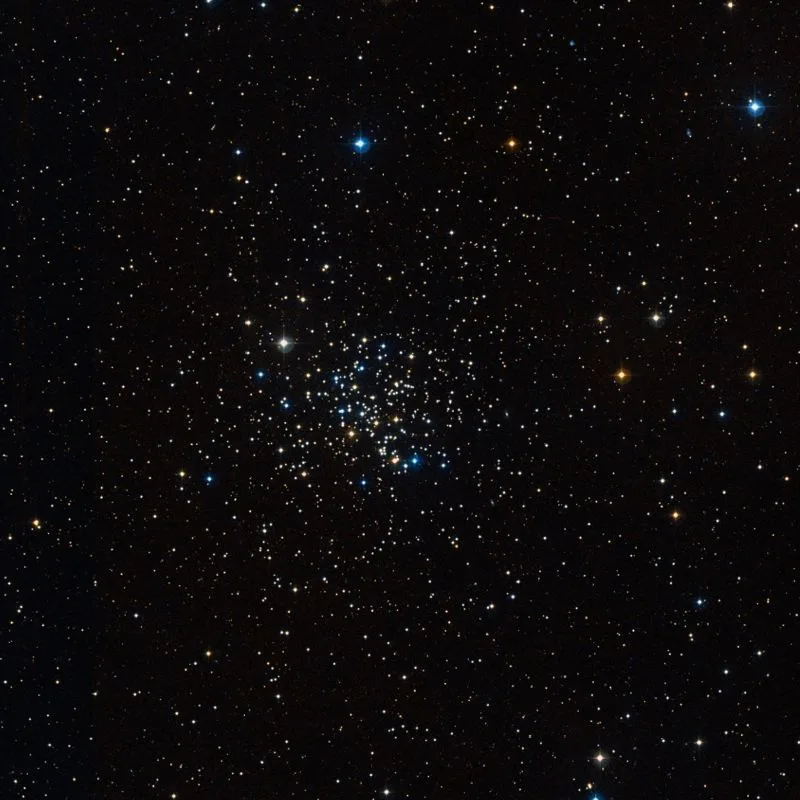
Most open clusters scatter within a few hundred million years, but M67 (NGC 2682) in Cancer has held together for billions. It shines at magnitude 6.1, covers about 27 arcminutes, and lies about 2,700 light-years away. That combination of great age and modest distance makes it one of the most studied star clusters in the sky, and a fine binocular target on winter and early spring evenings.
Observing tips
Find Acubens (Alpha Cancri), the star marking one of the crab's claws, and M67 lies just under 2 degrees to its west. Binoculars show it as a hazy patch that begins to sparkle with averted vision. A 70 to 100 mm telescope at 40x to 60x resolves dozens of faint, fairly even stars spread over about half a degree. With 200 mm, many more stars appear, with a few orange giants among them and faint chains and gaps across the field. Use low power, since the cluster is large enough that high magnification loses its outline.
A small telescope under reasonably dark skies is a good starting point; use the live altitude chart to choose its highest point.
What to expect
The stars of M67 formed together roughly 4 billion years ago with a chemical makeup close to the Sun's, so the cluster serves as a laboratory for Sun-like stars of known age. It also contains blue stragglers, stars that look younger than the rest because of mergers or mass transfer between companions.
At about 27 arcminutes, M67 suits 400 to 800 mm. Keep exposures short enough to preserve star colors, and process for subtle contrast between the yellow giants and the fainter white stars.