Observer's guide
About NGC 3627
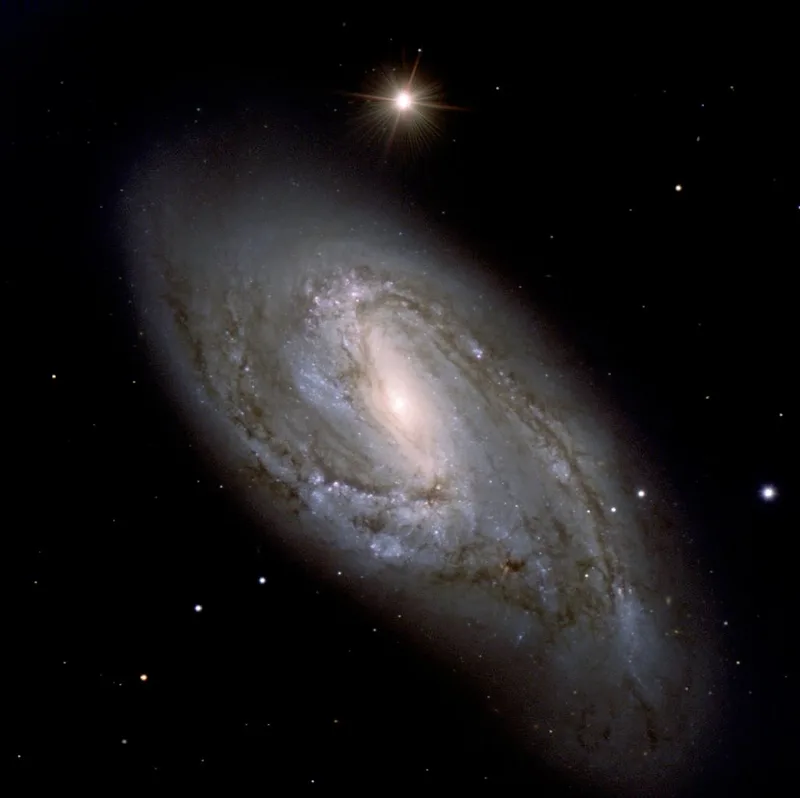
The brighter of the two Messier spirals in the Leo Triplet, M66 (NGC 3627) shines at magnitude 8.9 about 35 million light-years away. Unlike its smooth neighbor M65, it has visibly distorted arms and dust lanes, the result of gravitational encounters with the other galaxies of the group. It is one of the easiest galaxies in Leo for a small telescope.
Observing tips
Aim halfway between Chertan (Theta Leonis) and Iota Leonis, where M66 and M65 share a single low-power field, with M66 the eastern of the two. Under dark skies binoculars show a faint patch. A 70 to 100 mm telescope at 50x to 80x reveals a bright oval about 9 arcminutes long, wider and more irregular than M65. With 200 mm at 120x or more, look for the mottled texture of its arms and a dark lane along one side. The faint edge-on NGC 3628 to the north completes the triplet.
A small telescope under reasonably dark skies is a good starting point; use the live altitude chart to choose its highest point.
What to expect
M66 is an intermediate spiral with a weak bar, displaced arms and plenty of star formation. Its asymmetric shape is a sign of tidal interaction with NGC 3628, and several supernovae have been recorded in it.
A 400 to 600 mm frame covers the whole Leo Triplet, while 1000 mm or more shows the twisted arms and dust lanes of M66. Adding Ha highlights its pink star-forming regions.