Observer's guide
About NGC 3623
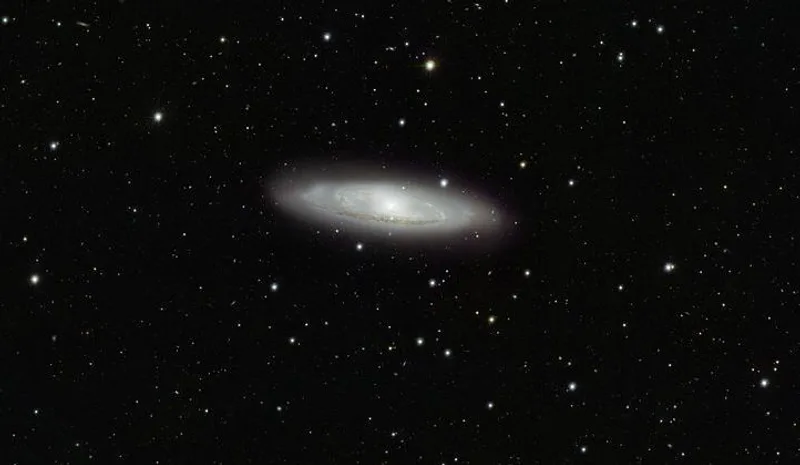
Together with M66 and NGC 3628, M65 (NGC 3623) makes up the Leo Triplet, one of the best known galaxy groups for small telescopes. This spiral of magnitude 9.3 lies about 35 million light-years away below the hindquarters of Leo. It appears as a long oval, about 10 by 3.3 arcminutes, because we see its disk at a steep angle.
Observing tips
Find Chertan (Theta Leonis) and Iota Leonis, then aim about halfway between them; the triplet sits just there. M65 is the western member of the bright pair, with M66 about 20 arcminutes to the east. In binoculars from a dark site, both look like faint smudges. A 70 to 100 mm scope at 50x shows them in one field as two elongated glows with brighter centers. With 200 mm at 100x, M65 shows a bright core in a sharply tapered oval, and NGC 3628 appears as a faint sliver to the north.
Because it is faint, use a larger aperture where possible, avoid bright Moon conditions, and use averted vision.
What to expect
M65 is an early-type spiral with tightly wound arms and a large central bulge. Most of its stars are old, and it shows relatively little current star formation compared with its neighbor M66.
The Leo Triplet spans about a degree, so 400 to 600 mm frames all three galaxies with room to spare. For M65 alone, 1200 mm or more resolves the bulge and its thin dust lanes.