Observer's guide
About Black Eye Galaxy
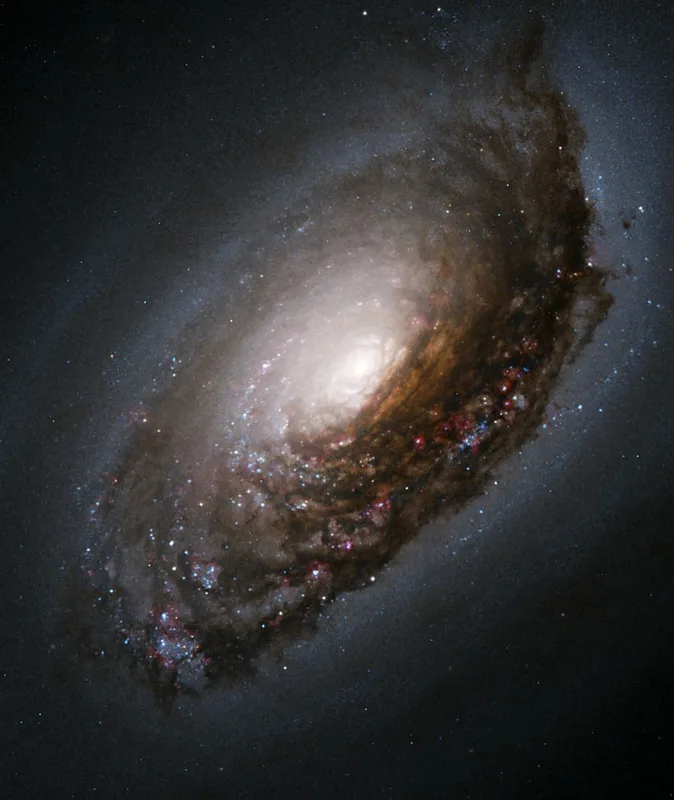
Known as the Black Eye Galaxy, and sometimes the Sleeping Beauty Galaxy, M64 (NGC 4826) is a bright spiral of magnitude 8.5 in Coma Berenices. It lies about 19 million light-years away. Its name comes from a dark band of dust in front of the nucleus, which can be seen in moderate telescopes and gives the galaxy its distinctive look.
Observing tips
Locate 35 Comae, a 5th-magnitude star about 5 degrees northwest of Alpha Comae, and M64 lies about 1 degree to its northeast. Binoculars show a small oval glow. A 70 to 100 mm telescope reveals a bright, elongated galaxy with a strong core. The dark dust lane becomes visible in 150 to 200 mm scopes at 100x to 150x as a dark arc beside the nucleus, like a bruise next to an eye. Good transparency matters more than aperture for this detail.
A small telescope under reasonably dark skies is a good starting point; use the live altitude chart to choose its highest point.
What to expect
The gas in M64 behaves unusually: the inner disk rotates in one direction while the outer gas rotates in the opposite direction. Astronomers think this is the result of a merger with a smaller gas-rich galaxy long ago, and active star formation is found where the two flows meet.
With a size of about 9 by 5 arcminutes, M64 fits nicely at 1000 to 1500 mm. Aim for good seeing to define the dust lane, and use long exposures for the faint, smooth outer disk.