Observer's guide
About Sunflower Galaxy
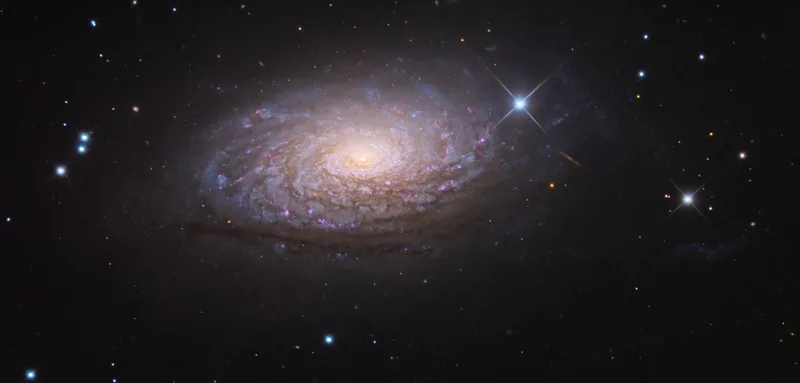
The Sunflower Galaxy, M63 or NGC 5055, is a bright spiral of magnitude 8.6 in Canes Venatici, about 31 million light-years away. Its nickname comes from its patchy, petal-like arms, which look quite different from grand-design spirals such as M51 in the same galaxy group. At 12 by 7.6 arcminutes it is large enough to show a clear oval shape even in small telescopes.
Observing tips
Start at Cor Caroli and look about a third of the way toward Alkaid, the end star of the Big Dipper's handle; M63 lies roughly 5 degrees from Cor Caroli. Binoculars show a small elongated haze under dark skies. A 70 to 100 mm scope reveals an oval glow with a bright, almost stellar core. In 200 mm or larger at 100x to 150x, the halo looks mottled, hinting at the clumpy arms, and the oval becomes noticeably extended. Averted vision helps pick up the faint outer edges.
A small telescope under reasonably dark skies is a good starting point; use the live altitude chart to choose its highest point.
What to expect
M63 is a flocculent spiral, meaning its arms are made of many short, patchy segments rather than two long continuous arms. Deep images reveal faint loops of stars around it, thought to be debris from a smaller galaxy it absorbed.
At 12 arcminutes, M63 fits well at 800 to 1200 mm. Very long integration under dark skies is needed to capture the faint stellar loops in its outer halo, which extend well beyond the bright disk.