Observer's guide
About NGC 4303
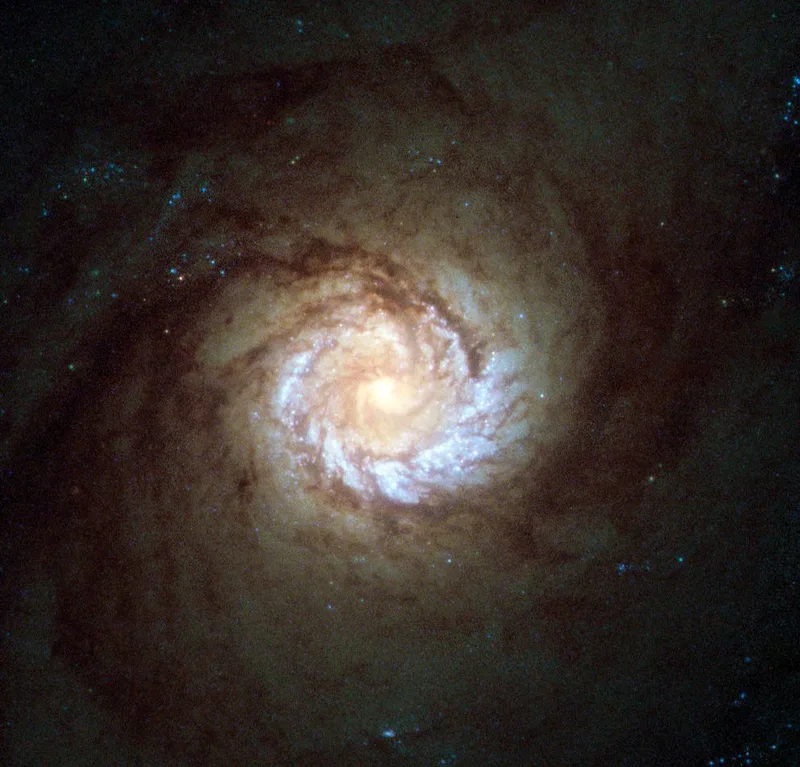
On the southern edge of the Virgo Cluster lies M61 (NGC 4303), a face-on barred spiral of magnitude 9.7 about 60 million light-years away. It is one of the larger spirals in the cluster and has produced an unusually high number of observed supernovae, which keeps it on the lists of supernova hunters. Visually it needs a dark sky, but its round shape and bright core repay patience.
Observing tips
Start at Eta Virginis (Zaniah) and move about 4 degrees north to 16 Virginis; M61 lies just over a degree north of that star, between 16 and 17 Virginis. Binoculars rarely show it. A 70 to 100 mm telescope shows a faint round glow with a brighter center, roughly 6 arcminutes across. With 200 mm or more at 120x to 150x, look for the bar and a hint of the two main arms using averted vision. It sits lower than most Virgo galaxies, so observe it near the meridian.
Because it is faint, use a larger aperture where possible, avoid bright Moon conditions, and use averted vision.
What to expect
M61 is an intermediate barred spiral with active star-forming regions along its arms, where massive stars are born and die quickly. That high rate of star formation explains its long list of observed supernovae.
The 6-arcminute disk of M61 calls for 1000 to 1500 mm to resolve the arms and pink star-forming knots. Adding Ha data to RGB brings out those knots, and comparing your images over the years may reveal a new supernova.