Observer's guide
About NGC 5904
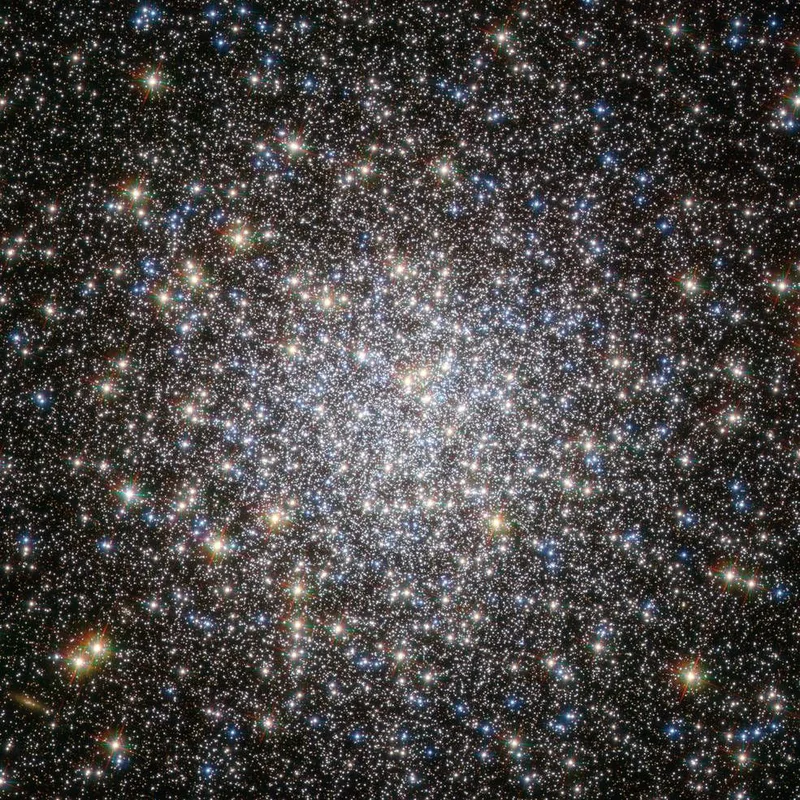
Many observers rank M5 (NGC 5904) as the finest globular cluster of the northern summer after M13. It lies in Serpens Caput, the head of the serpent, at magnitude 5.6 and about 20 arcminutes across, roughly 24,500 light-years away. Because it sits just north of the celestial equator, observers in both hemispheres can find it easily.
Observing tips
Look for 5 Serpentis, a 5th-magnitude star about 8 degrees southwest of Alpha Serpentis (Unukalhai). M5 lies only about 20 arcminutes northwest of it, and the pair fits easily in one binocular field. In binoculars the cluster looks like a fuzzy star with a bright center. A 70 to 100 mm scope at 100x shows a slightly oval glow with a grainy outer halo. With 200 mm or more at 150x to 200x, the cluster resolves to the core, and long curving star chains extend from its edges.
Its brightness makes it a practical binocular or small-telescope candidate when it is well above the horizon.
What to expect
M5 is one of the older globular clusters in the Milky Way, made of stars that formed very early in the galaxy's history. It contains well over 100,000 stars and more than a hundred known variable stars, most of them RR Lyrae types.
Frame the 17 to 20 arcminute halo at 800 to 1,200 mm. Short subexposures and careful focus help separate the dense core, and including nearby 5 Serpentis adds a bright reference star to the composition.