Observer's guide
About NGC 4621
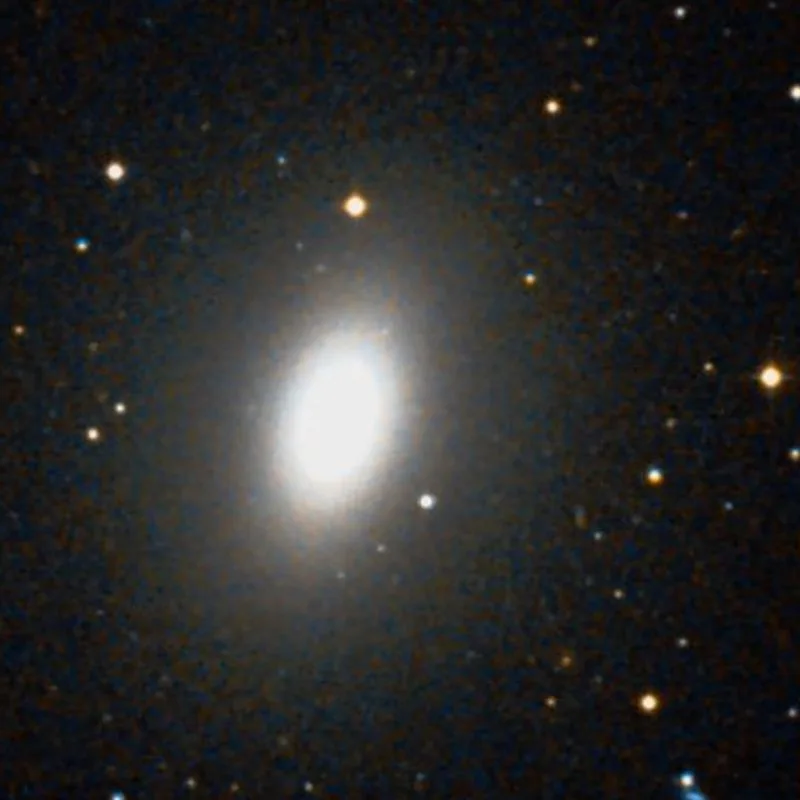
In the eastern part of the Virgo Cluster, M59 (NGC 4621) forms a close pair with the brighter elliptical M60, less than half a degree to its east. This elliptical galaxy shines at magnitude 9.6 and lies about 60 million light-years away. Observers usually view the two together in one low-power field, which makes it easy to compare the elongated shape of M59 with its rounder neighbor.
Observing tips
Hop about 4.5 degrees west from Vindemiatrix (Epsilon Virginis) to M60, then look about 25 arcminutes farther west for M59. Binoculars barely pick it up under dark skies. A 70 to 100 mm scope shows a small, elongated glow with a brighter middle, clearly more oval than M60. In a 200 mm telescope at 100x to 150x, the core looks almost star-like and the halo fades smoothly with no structure, as expected for an elliptical. Sweep slowly with a low-power eyepiece and M58 comes into view about a degree to the west.
Because it is faint, use a larger aperture where possible, avoid bright Moon conditions, and use averted vision.
What to expect
M59 is a giant elliptical galaxy made mostly of old, reddish stars, with little gas or dust left for new star formation. Like M60, it is a member of the Virgo Cluster, and it hosts a supermassive black hole at its center.
At about 5 by 3.4 arcminutes, M59 suits focal lengths around 1000 mm, but a 400 to 600 mm frame that includes M60 and M58 shows more context. Its smooth light needs careful background extraction rather than heavy stretching.