Observer's guide
About Ring Nebula
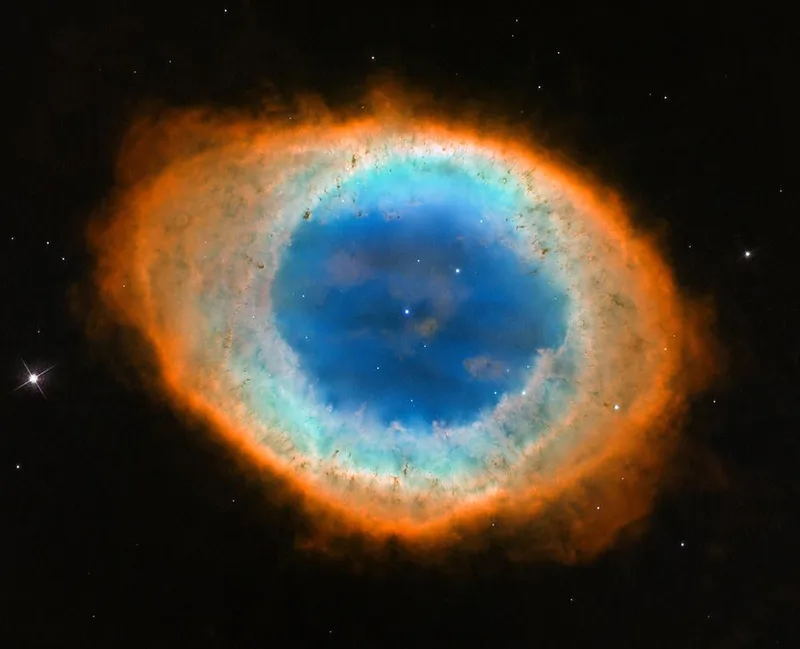
The Ring Nebula, M57 or NGC 6720, is the best known planetary nebula in the northern sky and one of the easiest to find. It sits in Lyra between Beta and Gamma Lyrae, about 4,100 light-years away. At magnitude 8.8 and only about 1.4 by 1.0 arcminutes across, it is small but bright, and its smoke-ring shape is obvious in almost any telescope.
Observing tips
Aim between Sheliak (Beta Lyrae) and Sulafat (Gamma Lyrae), the two stars at the southern end of Lyra's parallelogram; the nebula lies a little closer to Sheliak. Binoculars show at most a star-like point, but a 70 to 100 mm telescope at 80x to 100x reveals a small gray oval with a darker center. In a 200 mm scope at 150x to 250x, the ring looks slightly oval and brighter along its long sides. An OIII or UHC filter adds contrast, and the faint central star is a real test for large apertures in steady seeing.
A small telescope under reasonably dark skies is a good starting point; use the live altitude chart to choose its highest point.
What to expect
A planetary nebula forms when a Sun-like star runs out of fuel and sheds its outer layers. The exposed hot core, now a white dwarf, floods that gas with ultraviolet light and makes it glow. Detailed images suggest M57 is closer to a barrel or cylinder seen nearly end-on than a flat ring.
With a size of about 1.4 arcminutes, M57 rewards long focal lengths of 1500 mm or more. Combine Ha and OIII for the red and blue-green colors of the ring, and add long integration to bring out the faint outer halo.