Observer's guide
About NGC 6809
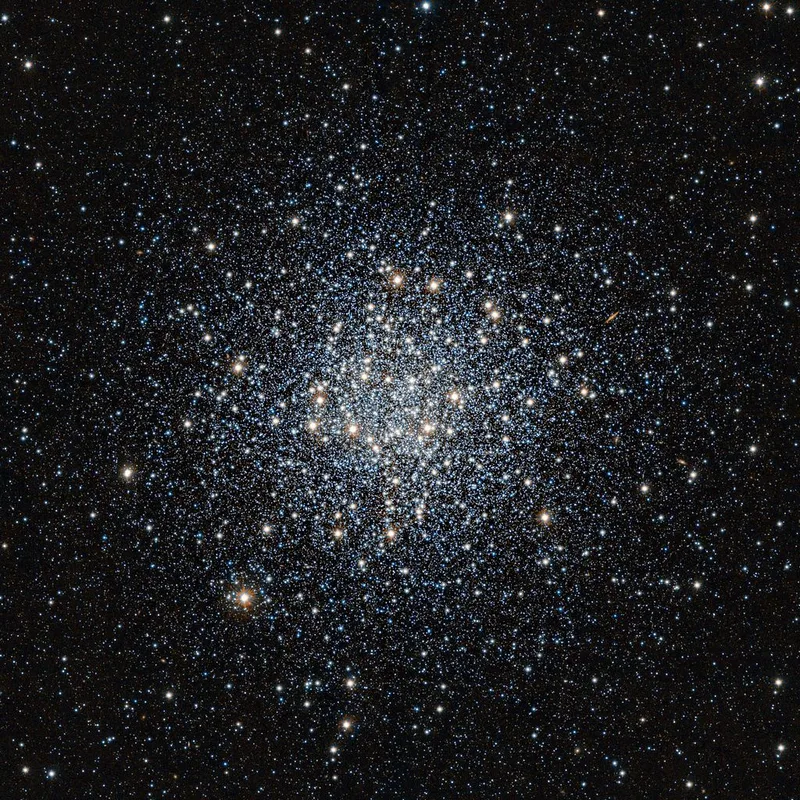
M55 (NGC 6809) is a large, loose globular cluster in southeastern Sagittarius, about 16,600 light-years away. At magnitude 6.3 and nearly 20 arcminutes across, it is bright and easy to resolve, but it sits so far south that from mid-northern latitudes it stays close to the horizon. Observers in the southern hemisphere see it high in a dark sky, where it is one of the finest globulars of the season.
Observing tips
From Zeta Sagittarii (Ascella), sweep about 8 degrees east; M55 lies in a fairly empty area away from the brightest Milky Way fields. In binoculars it shows as a large, faint, round glow. A 70 to 100 mm scope at 75x begins to resolve its outer stars, since the cluster has little central concentration. A 200 mm telescope at 150x resolves it well across its face. From 52 degrees north it rises only about 7 degrees, so you need a clear, flat southern horizon; south of about 40 degrees north it is much easier.
A small telescope under reasonably dark skies is a good starting point; use the live altitude chart to choose its highest point.
What to expect
M55 is an old, metal-poor globular cluster in the Milky Way's halo. Its loose structure makes it easy to study star by star, and its eclipsing binary stars have been used to measure the cluster's age and distance directly.
At about 19 arcminutes, M55 frames well at 600 to 1,000 mm. Its loose core allows moderate exposures, but from northern sites low altitude causes extinction and color shifts, so image at the meridian.