Observer's guide
About NGC 6715
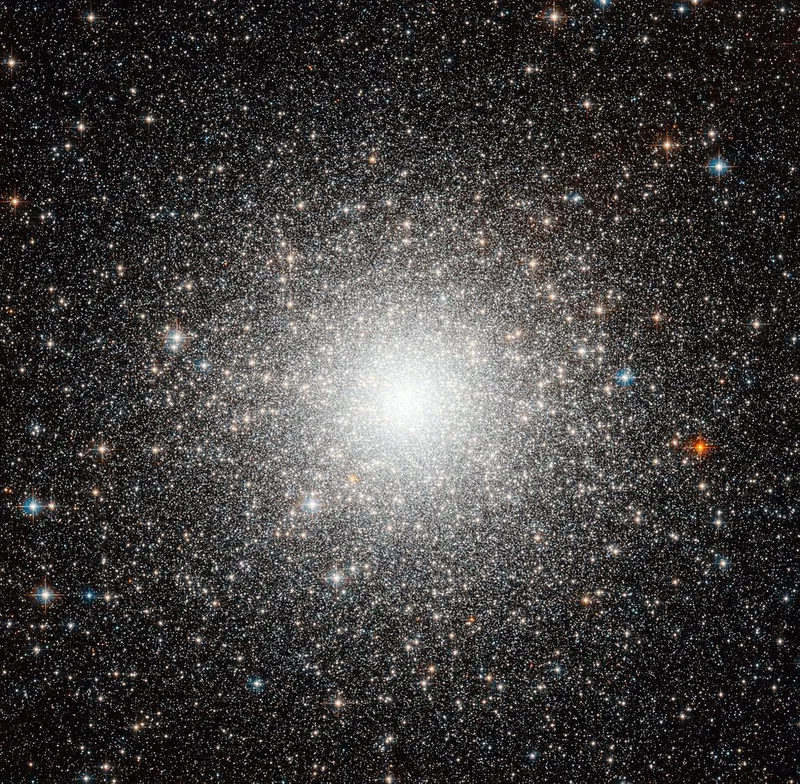
M54 (NGC 6715) is a compact globular cluster in Sagittarius, near the bottom of the Teapot. It lies about 82,800 light-years away, much farther than most Messier globulars, and in 1994 astronomers realized it belongs to the Sagittarius Dwarf Spheroidal Galaxy. That makes it a globular cluster from another galaxy, one that Messier spotted in 1778 long before anyone could have known.
Observing tips
Start at Zeta Sagittarii (Ascella), where the Teapot's handle meets its base, and move about 1.75 degrees west-southwest. M54 appears in binoculars as a faint fuzzy star. A 70 to 100 mm scope at 100x shows a small, bright core with a faint halo. In a 200 mm telescope the core is very concentrated and nearly stellar, and resolving the halo needs 300 mm or more. From 52 degrees north it barely clears 7 degrees, so it is mainly a target for southern Europe and farther south.
A small telescope under reasonably dark skies is a good starting point; use the live altitude chart to choose its highest point.
What to expect
M54 sits near the center of the Sagittarius Dwarf Spheroidal Galaxy, a small satellite galaxy being pulled apart by the Milky Way's gravity. Some astronomers think M54 may be the dwarf galaxy's nucleus, or lie very close to it.
At about 9 arcminutes, M54 suits 1,000 to 2,000 mm. Its stars are faint, so long integration and good seeing help, while low altitude from northern sites limits the detail you can record.