Observer's guide
About NGC 7654
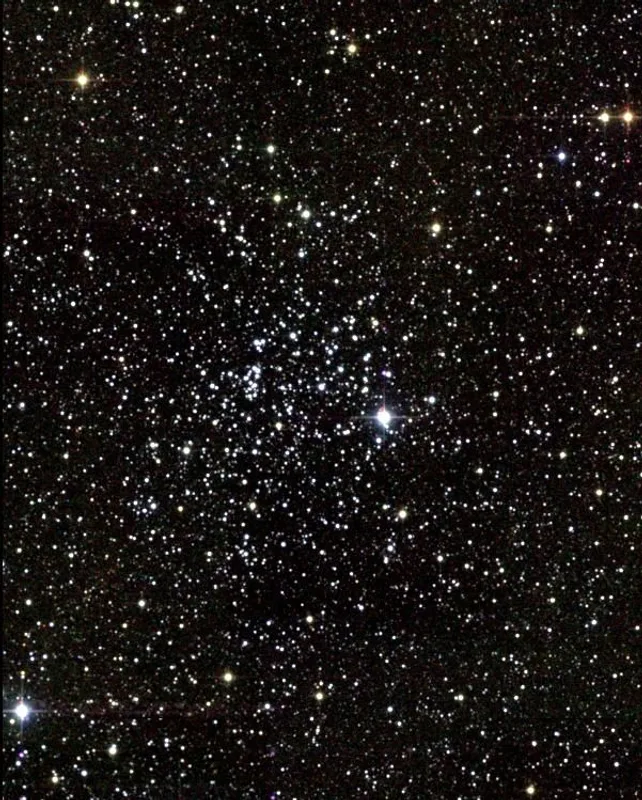
M52 (NGC 7654) is a rich open cluster in Cassiopeia, about 5,000 light-years away, on the edge of a bright stretch of Milky Way. At magnitude 7.3 it is compact, about 13 arcminutes across, with a brighter yellow-orange star on its southwestern edge. The Bubble Nebula, NGC 7635, lies less than a degree to the southwest, making a good pairing for larger telescopes.
Observing tips
Draw a line from Schedar (Alpha Cassiopeiae) through Caph (Beta Cassiopeiae) and extend it about the same distance again; M52 lies there. Binoculars show a small, fuzzy patch. A 70 to 100 mm scope at 50x to 75x resolves dozens of faint stars in a fan shape with the brighter star on its edge. A 200 mm telescope reveals many more stars, and with a UHC or OIII filter you may detect the faint Bubble Nebula nearby. M52 is circumpolar from northern Europe, so you can find it on any clear night of the year.
A small telescope under reasonably dark skies is a good starting point; use the live altitude chart to choose its highest point.
What to expect
M52 is a fairly young open cluster, tens of millions of years old, with a population of hot blue stars and a few evolved giants. It lies in the Perseus Arm of the galaxy, a region that also hosts many other young clusters and nebulae.
A focal length of 600 to 1,000 mm frames M52 with the Bubble Nebula. Use H-alpha and OIII to capture the Bubble, and broadband color for the cluster.