Observer's guide
About NGC 2323
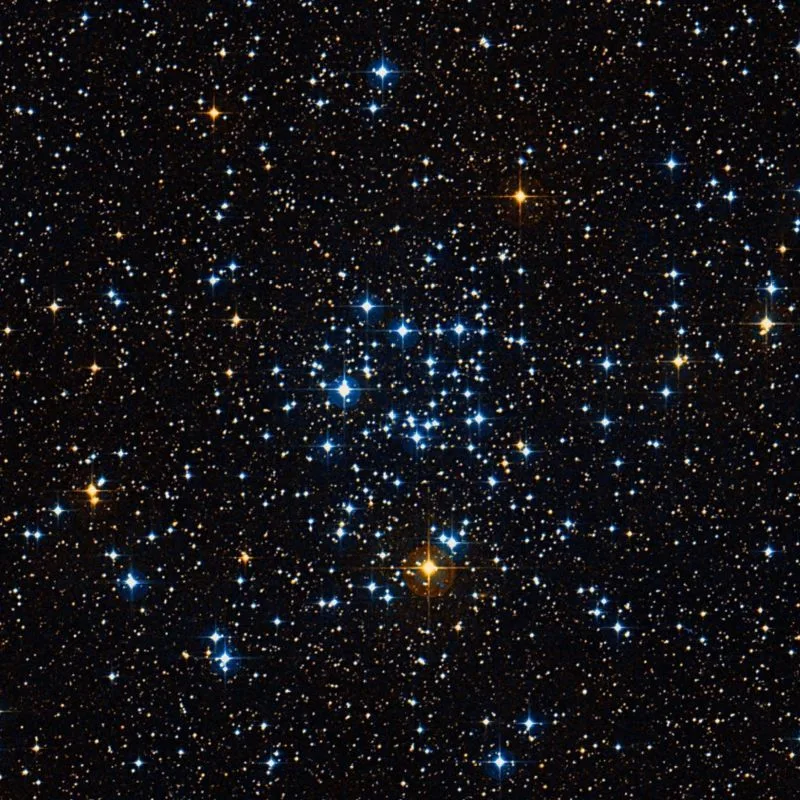
M50 (NGC 2323) is an open cluster in Monoceros, about 3,000 light-years away, lying roughly a third of the way from Sirius to Procyon. It shines at magnitude 6.3 and has a slightly heart-shaped outline, with a reddish star near its southern edge. In the faint constellation Monoceros it is one of the easier deep-sky objects to find.
Observing tips
Imagine a line from Sirius to Procyon and stop about one-third of the way along; M50 shows in binoculars there as a misty patch. A 70 to 100 mm scope at 40x to 60x resolves a few dozen stars and shows the heart-shaped outline. A 200 mm telescope at 75x to 100x reveals many more members and the reddish star south of center. From 52 degrees north it reaches about 30 degrees, so it is best observed near the meridian.
A small telescope under reasonably dark skies is a good starting point; use the live altitude chart to choose its highest point.
What to expect
M50 is an open cluster a little over 100 million years old, containing a few hundred stars. Its main members are blue-white B and A stars, while the reddish star near its edge is an evolved giant.
A focal length of 600 to 900 mm frames M50 with some surrounding star field. Keep exposure lengths moderate to retain the color of the red giant against the bluer cluster stars.