Observer's guide
About NGC 4472
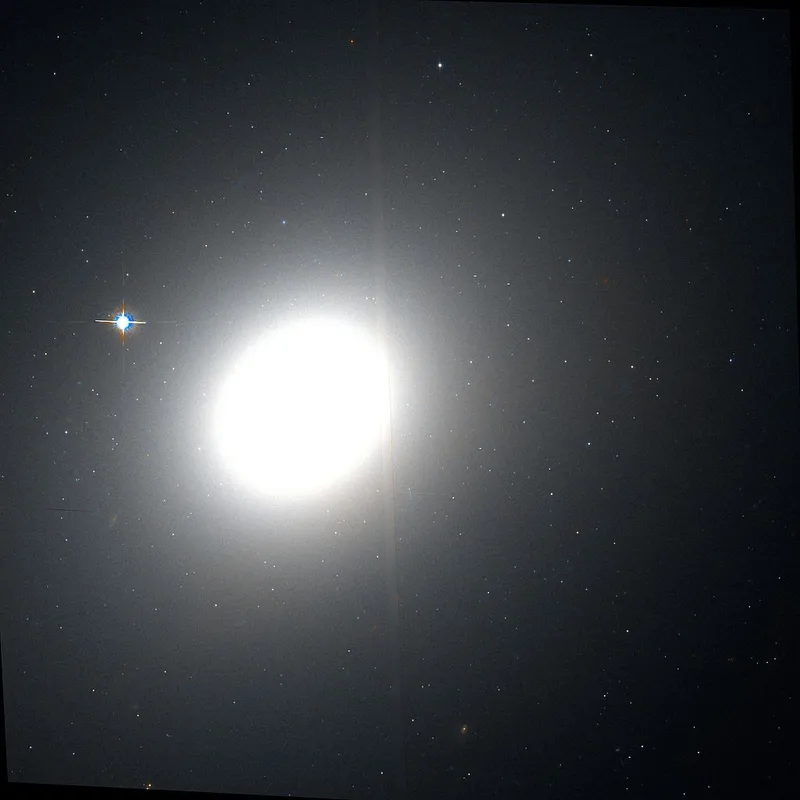
M49 (NGC 4472) is a giant elliptical galaxy and the brightest member of the Virgo Cluster, shining at magnitude 8.4. It lies in Virgo, some 60 million light-years away, and it was the first member of the Virgo Cluster to be discovered, by Messier in 1771. Its bright core and smooth, oval halo make it one of the easier galaxies in the region for small telescopes.
Observing tips
M49 lies about 8 degrees west-southwest of Vindemiatrix (Epsilon Virginis), in an area with few bright stars, so a finder chart helps. In binoculars it shows as a small, faint, round glow. A 70 to 100 mm scope at 50x to 80x shows an oval haze with a bright center and no further detail. With 200 mm or more, the core looks brighter, and you can sweep the area for other Virgo galaxies within a few degrees, including M58 and M61. Galaxies like this benefit more from a dark sky than from magnification.
A small telescope under reasonably dark skies is a good starting point; use the live altitude chart to choose its highest point.
What to expect
M49 is a giant elliptical containing hundreds of billions of stars and thousands of globular clusters. It anchors its own subgroup within the Virgo Cluster and has a supermassive black hole at its center.
At about 8 by 7 arcminutes, M49 suits 1,000 to 2,000 mm. Long total exposure shows its extended halo, and a wider 500 mm frame can include several neighboring Virgo galaxies.