Observer's guide
About NGC 2437
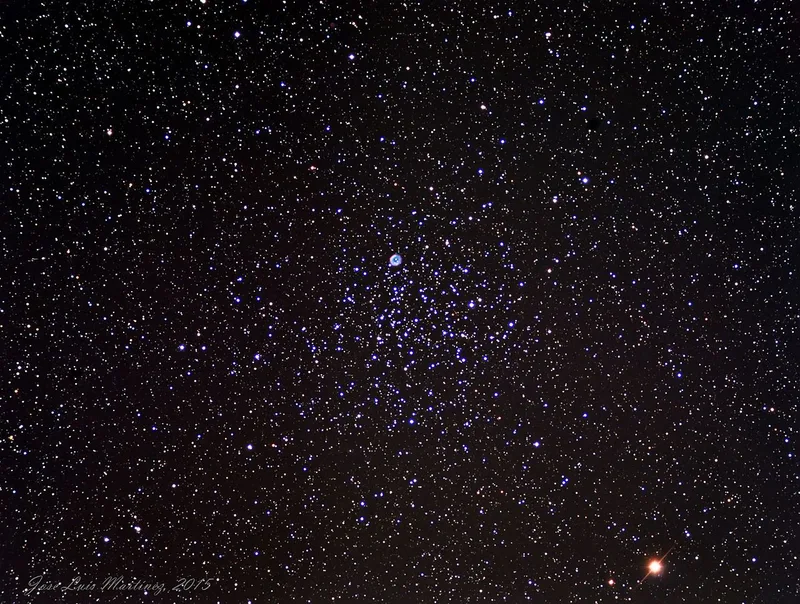
M46 (NGC 2437) is a rich open cluster in Puppis, about 5,400 light-years away, best known for the small planetary nebula NGC 2438 that appears within it. The cluster shines at magnitude 6 and spans about 24 arcminutes, with dozens of faint stars of similar brightness. It lies just 1.3 degrees east of the brighter but sparser M47, and the contrast between the two is part of the appeal.
Observing tips
From Sirius, sweep about 14 degrees east into Puppis; M47 is the brighter cluster, and M46 lies 1.3 degrees beyond it to the east. In binoculars, M46 shows as a rich, misty glow next to the brighter stars of M47. A 70 to 100 mm scope at 50x resolves many faint stars and, with an OIII or UHC filter, shows NGC 2438 as a small gray disk near the northern edge. With 200 mm and an OIII filter, the planetary shows its ring shape. Northern observers see it at around 23 degrees, so pick a night with good transparency.
Its brightness makes it a practical binocular or small-telescope candidate when it is well above the horizon.
What to expect
M46 is an open cluster several hundred million years old. The planetary nebula NGC 2438 is probably not a member; its measured velocity differs from the cluster's, which suggests it lies in front along the same line of sight.
A focal length of 600 to 1,000 mm frames M46 with NGC 2438, or 300 to 400 mm includes M47 too. Adding OIII and H-alpha data helps bring out the planetary nebula's ring.