Observer's guide
About Pleiades
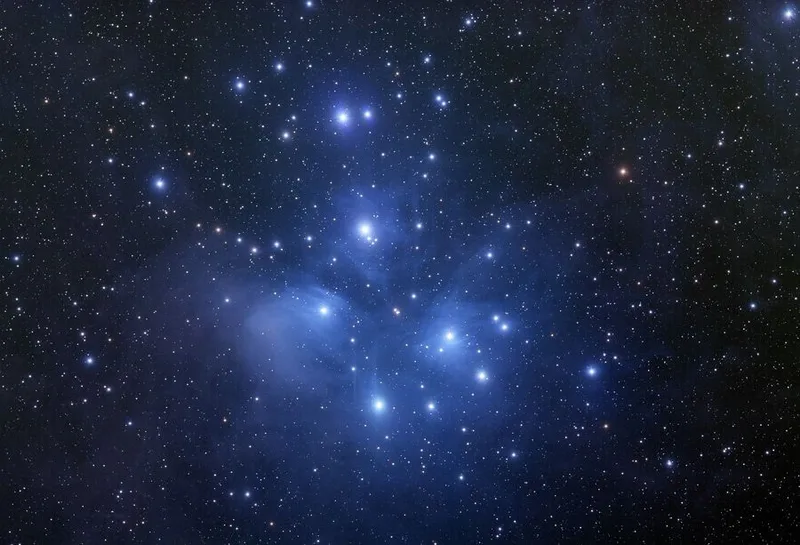
The Pleiades, M45, also called the Seven Sisters and known in Japan as Subaru, is the best-known star cluster in the sky. It lies in Taurus, northwest of Aldebaran, and at magnitude 1.6 its brightest stars form a small dipper shape visible even from city centers. Most people see six or seven stars with the naked eye, and including its outlying members the cluster spans about 2 degrees.
Observing tips
Follow the line of Orion's Belt northwest past Aldebaran and the cluster is unmistakable. Binoculars give the best overall view, showing dozens of blue-white stars around Alcyone, the brightest member. A 70 to 100 mm scope at 20x to 30x fits the main group and shows close pairs and faint stars between the bright ones. With 200 mm, clean dew-free optics and a dark night, look for the faint reflection nebula around Merope as a soft haze. Avoid high power, which spreads the cluster beyond the field.
Its brightness makes it a practical binocular or small-telescope candidate when it is well above the horizon.
What to expect
The Pleiades are a young open cluster around 100 million years old, with more than 1,000 members. The blue nebulosity in photographs is not the cluster's birth cloud but an unrelated cloud of dust that the stars are passing through, reflecting their light.
At about 2 degrees, the Pleiades frame well at 200 to 500 mm. Long integration under dark skies reveals the blue reflection nebula and the faint dust surrounding the cluster.