Observer's guide
About Beehive Cluster
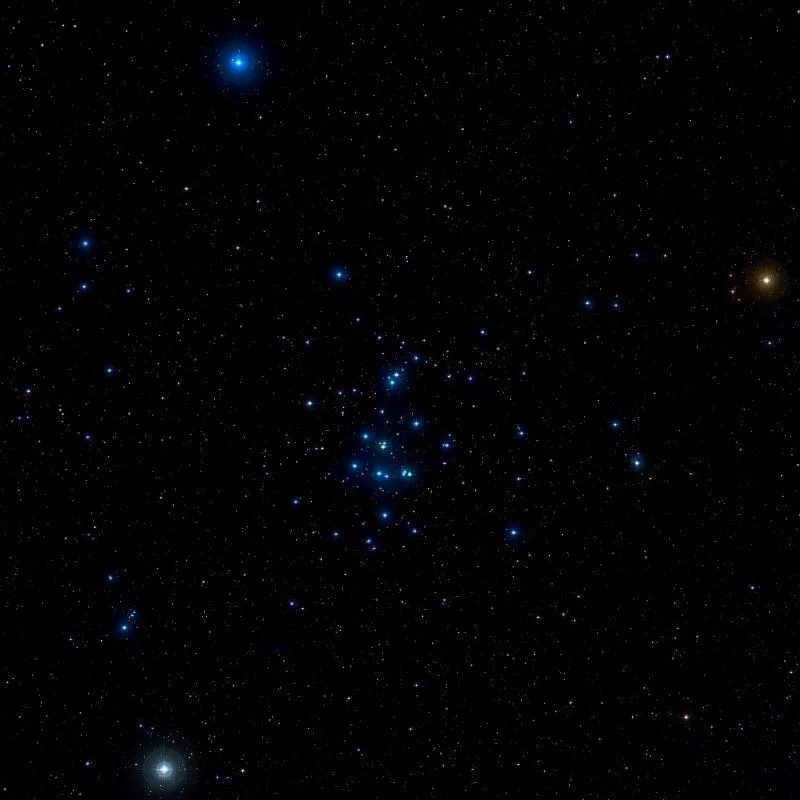
The Beehive Cluster, M44 (NGC 2632), also known by its old name Praesepe, is one of the nearest open clusters to the Sun at about 577 light-years. It lies in the middle of Cancer and shines at magnitude 3.7 across more than a degree, so it shows as a faint glow to the naked eye from a reasonably dark site. Galileo was the first to see that the glow is made of many individual stars.
Observing tips
Find the faint stars of Cancer between Regulus and the Gemini twins, then look for Gamma and Delta Cancri, the two Aselli; M44 lies just west of the line between them. Binoculars give the best view, showing dozens of stars over a field larger than the full Moon. In a 70 to 100 mm scope, use your lowest power, around 20x, to fit the cluster in. A 200 mm telescope can only show part of it at once, but it is useful for picking out the orange giants and close pairs within it.
Its brightness makes it a practical binocular or small-telescope candidate when it is well above the horizon.
What to expect
M44 is about 600 million years old, and its age and motion through space are similar to those of the Hyades in Taurus, suggesting the two clusters may share a common origin. It contains about 1,000 stars, including several red giants and white dwarfs.
At more than a degree across, M44 suits 200 to 400 mm. Short exposures with good color balance bring out the orange giants among the white stars.