Observer's guide
About de Mairan's Nebula
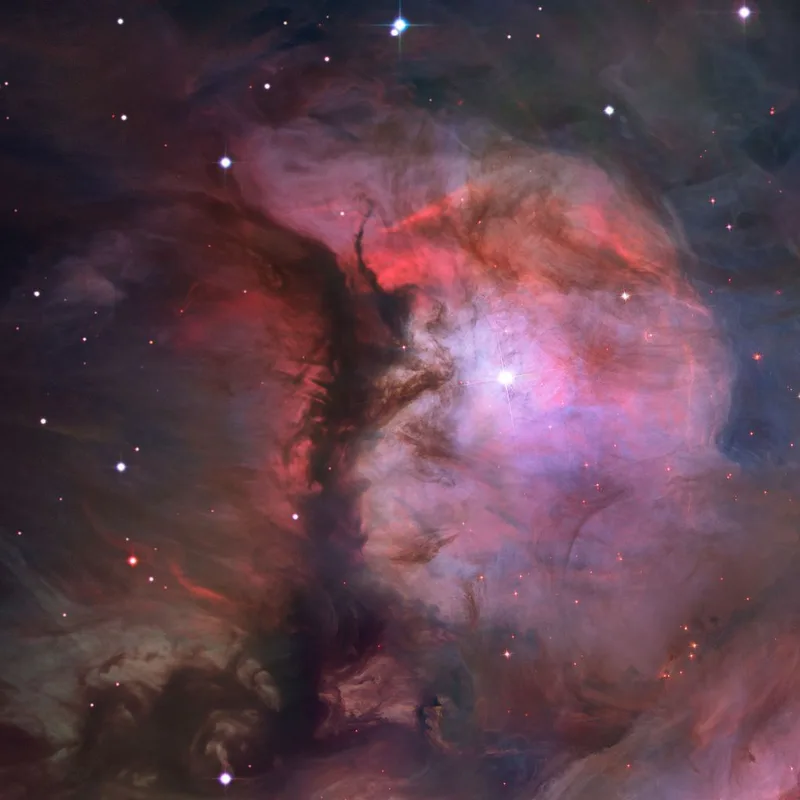
De Mairan's Nebula, M43 (NGC 1982), is a separate part of the Orion Nebula complex, lying just north of M42 across a dark lane of dust. It glows at magnitude 9 around a single bright star, and although long exposures show it spanning about 20 by 15 arcminutes, it looks much smaller at the eyepiece. Jean-Jacques d'Ortous de Mairan described it in the 18th century, before Messier added it to his list.
Observing tips
Find M42 in Orion's Sword and look just north of it, beyond the dark wedge known as the Fish's Mouth; M43 is the comma-shaped glow around a 7th-magnitude star. Binoculars rarely show it separately from M42. In a 70 to 100 mm scope at 60x to 100x, it appears as a small, round patch around the star. A 200 mm telescope with a UHC filter shows its distinct comma shape and the dark lane separating it from the main nebula. Moderate to high power helps, since it is easily swamped by the glare of M42.
Because it is faint, use a larger aperture where possible, avoid bright Moon conditions, and use averted vision.
What to expect
M43 is an HII region lit mainly by the hot star NU Orionis at its center. It belongs to the same molecular cloud as M42, about 1,600 light-years away, and only a lane of foreground dust makes the two look like distinct nebulae.
M43 is best captured in the same frame as M42 at 400 to 1,000 mm. Blend exposures carefully so its comma shape and the dark lane stay visible beside the much brighter core of M42.