Observer's guide
About Orion Nebula
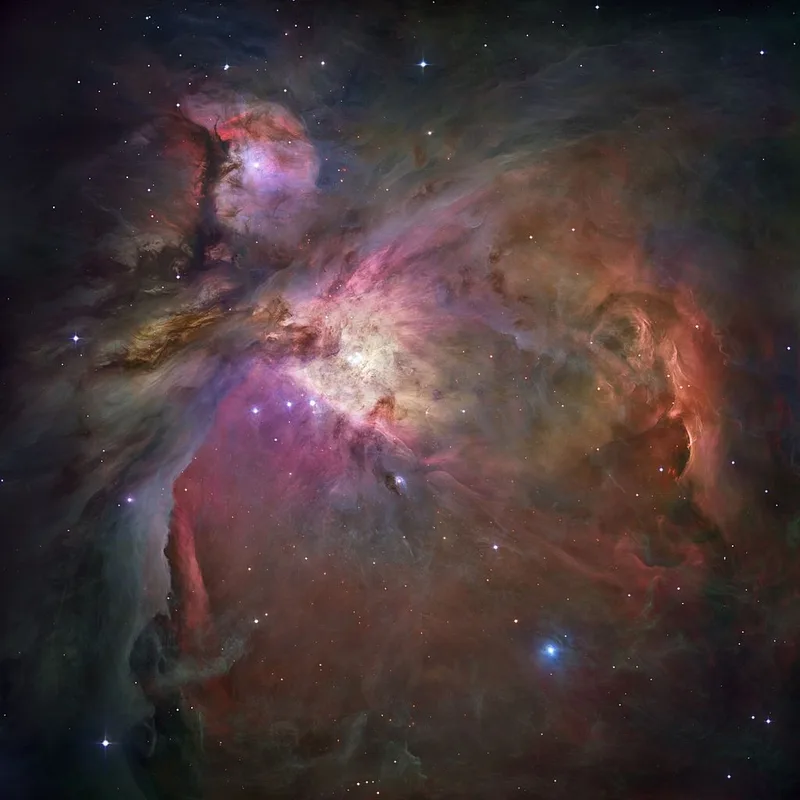
The Orion Nebula, M42 (NGC 1976), also called the Great Orion Nebula, is the brightest diffuse nebula in the night sky and the most often observed. It sits in Orion's Sword, below the three Belt stars, and at magnitude 4 it shows to the naked eye as a hazy patch around the middle star of the sword. It lies about 1,600 light-years away and is the nearest region of massive star formation to the Sun.
Observing tips
Find the three Belt stars of Orion and look south to the short line of stars forming the Sword; the fuzzy middle star is M42. Binoculars show a bright, fan-shaped glow. A 70 to 100 mm scope at 40x to 80x shows the wings of nebulosity and the four stars of the Trapezium at its heart. With 200 mm or more, the structure becomes complex, with dark bays, ripples and a faint greenish tinge, and a UHC filter extends the faint outer loops. Push the magnification on the Trapezium to look for its fainter E and F stars.
Its brightness makes it a practical binocular or small-telescope candidate when it is well above the horizon.
What to expect
M42 is part of a vast cloud of gas and dust, the Orion molecular cloud complex, where new stars are forming today. The hot young stars of the Trapezium ionize the gas around them, and Hubble has imaged many protoplanetary disks around young stars in the nebula.
At around 1 degree, M42 fits well at 400 to 800 mm along with M43 and the nearby Running Man Nebula. Combine short and long exposures to control the bright core around the Trapezium while capturing the faint outer wings.