Observer's guide
About NGC 2287
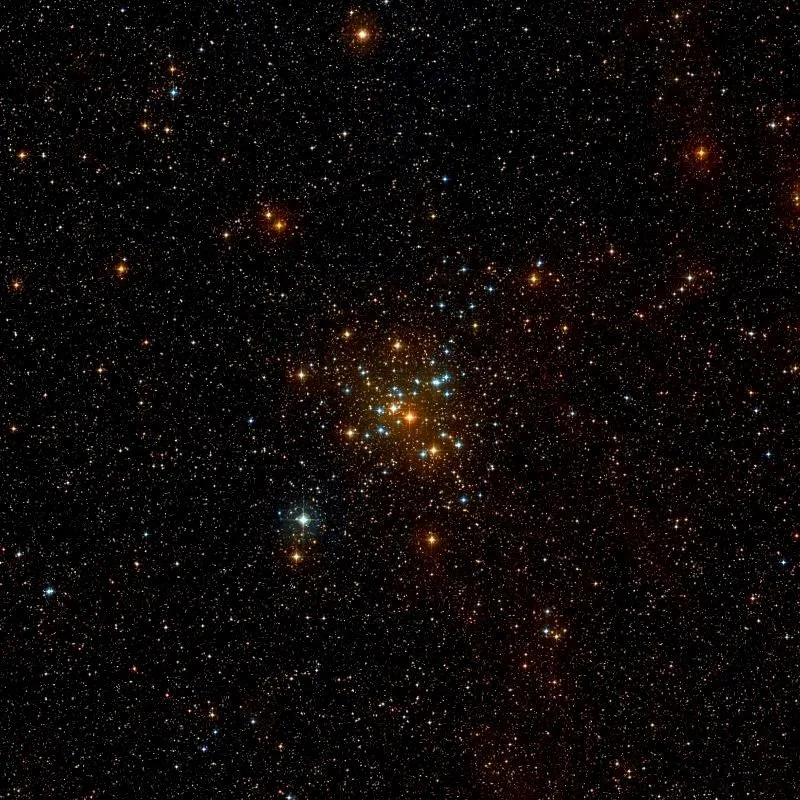
About 4 degrees south of Sirius lies M41 (NGC 2287), a bright open cluster in Canis Major sometimes called the Little Beehive. It shines at magnitude 4.6 and spans about 30 arcminutes, and from a dark site it is visible to the naked eye as a hazy spot. It lies around 2,300 light-years away and contains a handful of orange giants that stand out among its white stars.
Observing tips
Center Sirius and drop about 4 degrees due south; M41 appears in the same binocular field, an easy find. Binoculars show a round group of stars with an orange star near the center. A 70 to 100 mm scope at 30x to 50x resolves several dozen stars, some arranged in curved chains. A 200 mm telescope shows a richer field but works best at low power. From 52 degrees north it peaks near 17 degrees, so look for it when Sirius is highest on winter evenings.
Its brightness makes it a practical binocular or small-telescope candidate when it is well above the horizon.
What to expect
M41 is an open cluster around 200 million years old. Its orange giants have already left the main sequence, while the many white and blue-white stars are still burning hydrogen in their cores, so the cluster's age shows at a glance in a color image.
At about half a degree, M41 frames well at 400 to 700 mm. A wider 135 mm frame can include Sirius, though its glare needs careful processing.